How Long Do EV Batteries Last? Real-World Data Explained
Most electric car batteries last well over a decade and lose only about 2% of their capacity per year. Here is what real-world data says about EV battery life, what wears batteries out and how to make yours last longer.
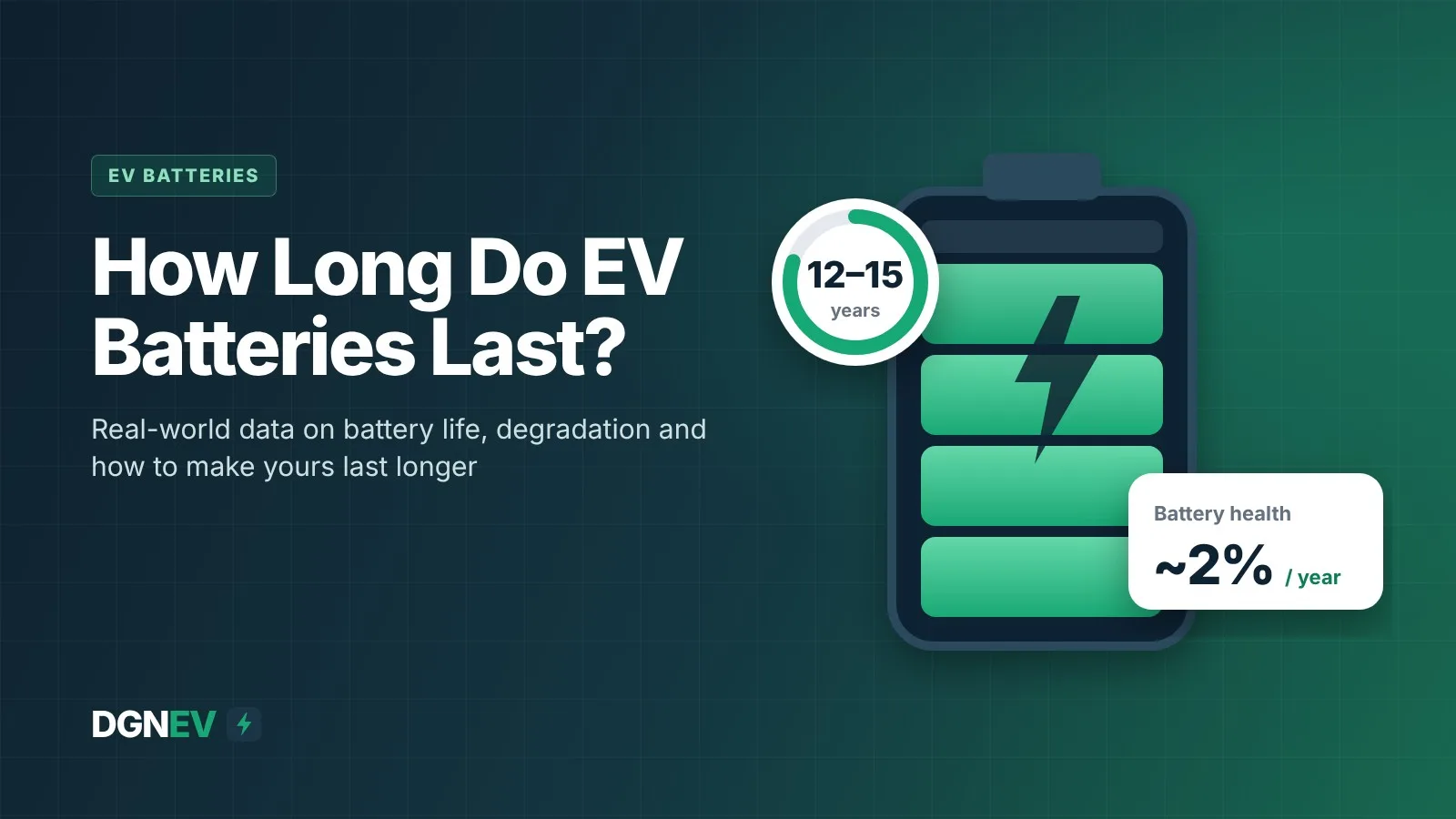
Most electric car batteries last much longer than people expect. The U.S. Department of Energy estimates that EV batteries may last 12 to 15 years in moderate climates and 8 to 12 years in severe climates. Real-world data backs this up: a 2026 study of more than 22,700 electric vehicles by fleet telematics company Geotab found that batteries lose about 2.3% of their capacity per year on average.
In other words, a typical EV battery will still hold around 80% of its original capacity after eight to ten years – and battery replacements are rare. Below, we look at what the data says, what makes batteries wear faster and what you can do to keep yours healthy.
New to EVs? Read our guide on how electric cars work first.
How long do EV batteries really last?
An EV battery does not suddenly stop working at the end of its life. Instead, it slowly loses capacity – the amount of energy it can store – so your driving range gets a little shorter over time. This gradual loss is called battery degradation.
Here is what the largest real-world studies show:
- Geotab (January 2026): across more than 22,700 EVs from 21 makes and models, batteries lost an average of 2.3% of their capacity per year.
- Tesla (2022 Impact Report): Tesla reported that its Model S and Model X batteries lost just 12% of their capacity on average after 200,000 miles (about 320,000 km).
- Recurrent (2025): fewer than 4% of EV owners in its data had their battery replaced, excluding major recalls – and only 0.3% for 2022 and newer models.
Put simply, for most drivers the battery is likely to last as long as the rest of the car.
What battery degradation means for your range
Degradation shows up as a slightly lower range on a full charge. For example, a car with 300 miles (480 km) of range that loses 2.3% of its capacity per year would still offer around 245 miles (390 km) after eight years. For most daily driving, that difference is barely noticeable.
The chart below shows how capacity might change over ten years at the average rates measured by Geotab for different charging habits.
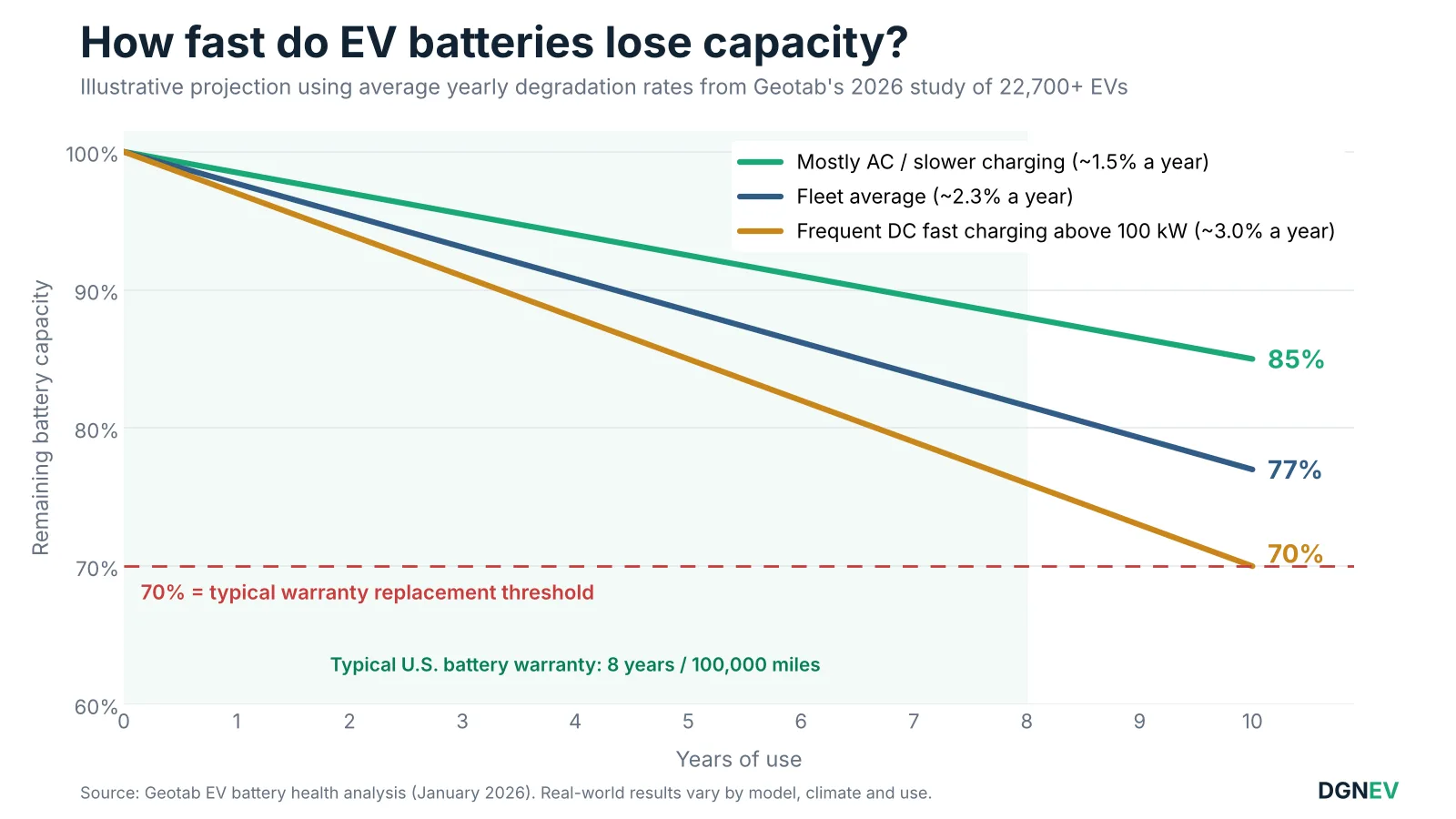
Many batteries also lose a little more capacity in the first year or two and then level off, so a small early drop is normal and not a sign of a faulty battery.
What affects EV battery life?
Frequent DC fast charging
Charging power was the strongest factor in Geotab's study. Vehicles that relied heavily on DC fast charging above 100 kW degraded at up to 3.0% per year – about double the roughly 1.5% per year seen in vehicles that mainly used AC or lower-power charging. Fast charging now and then on road trips is fine; using it every day adds extra wear.
Heat
High temperatures speed up the chemical reactions that wear out battery cells. Geotab found that vehicles in hotter regions degraded about 0.4% faster per year than those in mild climates. Modern EVs actively cool their batteries, which limits the damage, but parking in the shade and in garages still helps.
Spending long periods at very high or very low charge
Batteries are under the most stress when they sit at nearly 100% or nearly 0% for long periods. Geotab found that simply using a wide charge range did not meaningfully increase degradation – the effect appeared mainly when vehicles spent more than 80% of their time at very high or very low charge levels.
How much the car is driven
Heavily used vehicles degrade a bit faster – about 0.8% per year more than the lowest-use group in Geotab's data. That is the natural trade-off for driving more miles.
Battery chemistry
Different battery types age differently. Lithium iron phosphate (LFP) batteries, used in many standard-range models, generally tolerate frequent full charges and many charge cycles very well. Nickel-based batteries (such as NMC) store more energy for their weight and are usually best kept below 100% for daily use. Always follow the charging advice in your owner's manual.
How often do EV batteries need to be replaced?
Rarely. According to Recurrent's data, fewer than 4% of EV owners have had a battery replaced, not counting major recalls. The rate is much higher for the very first generation of EVs (about 8.5% for 2011–2016 models) and much lower for newer cars: about 2% for 2017–2021 models and just 0.3% for 2022 and newer models.
Many early replacements were caused by manufacturing defects rather than normal aging, and these are usually covered by the manufacturer's warranty. When a battery does need to be replaced outside warranty, it can cost several thousand dollars or more, depending on the model – which is why the warranty matters when you buy, especially when buying used.
EV battery warranties explained
Battery warranties are some of the longest in the car industry:
- United States: according to Kelley Blue Book, federal rules require EV batteries to be covered for at least 8 years or 100,000 miles. High-voltage batteries in plug-in hybrids must be covered for 8 years or 80,000 miles.
- California: starting with the 2026 model year, EV batteries must retain at least 70% of their range for 10 years or 150,000 miles, rising to 80% for 2030 and later models.
- Capacity threshold: most warranties replace or repair a battery if its capacity falls below about 70% within the warranty period. Tesla and Volkswagen (for the ID.4) use 70%, while Nissan uses 75% for the Leaf.
Warranty terms vary by brand and country, so check the exact coverage for your vehicle – including whether it transfers to a second owner.
How to make your EV battery last longer
- Follow your car's charging advice. Many manufacturers recommend charging to around 80–90% for daily driving with nickel-based batteries and saving 100% for road trips. Cars with LFP batteries are often designed to be charged to 100% regularly.
- Use AC charging for everyday needs. Charge at home or work when you can and save DC fast charging for longer trips.
- Don't leave the car sitting at 100% or near 0% for days. If you will park for a long time, aim for a mid-level charge, often around 50%.
- Keep it cool in hot weather. Park in the shade or a garage, and leave the car plugged in when possible so it can manage its own battery temperature.
- Precondition before fast charging in winter. Many EVs can warm the battery on the way to a fast charger, which makes charging quicker and gentler.
- Install software updates. Manufacturers regularly improve battery management and charging through updates.
Buying a used EV? Check the battery
When buying a used electric car, the battery's condition matters more than the odometer. Before you buy:
- Ask for a battery health report (often shown as "state of health" or SOH). Some dealers provide one, and independent services can create one from the car's data.
- Compare the car's current full-charge range with the original rated range.
- Check how much of the battery warranty is left and whether it transfers to you.
- Look for any open recalls related to the battery.
Frequently asked questions
Do EV batteries last longer than the car?
In most cases, they are expected to last as long as the rest of the car. With average degradation of around 2.3% per year, a typical battery still holds roughly 75–80% of its capacity after ten years, which is enough for most daily driving.
Is it bad to charge my EV to 100%?
Not occasionally. For nickel-based batteries, keeping the car at 100% for long periods adds stress, so many owners set a daily limit of 80–90% and charge fully before long trips. LFP batteries are usually fine to charge to 100% regularly. Your owner's manual will tell you what your car's maker recommends.
Does fast charging damage the battery?
Occasional fast charging does little harm. Relying on high-power DC fast charging for most of your charging is linked to faster degradation – about 3.0% per year versus around 1.5% for mainly AC charging in Geotab's study.
Can part of an EV battery be repaired instead of replaced?
Often, yes. Battery packs are made of modules, and specialist repairers or dealers can sometimes replace individual faulty modules, which is far cheaper than replacing the entire pack.
What happens to old EV batteries?
Batteries that are no longer ideal for driving often still hold 70% or more of their capacity. They can be reused for stationary energy storage or recycled to recover valuable materials such as lithium, nickel and cobalt.
The bottom line
EV batteries are proving to be very durable. On average they lose about 2–3% of their capacity per year, are expected to last 12 to 15 years in moderate climates and are protected by warranties of at least 8 years or 100,000 miles in the U.S. Charging mostly on AC power, avoiding long periods at very high or very low charge and keeping the battery cool will help yours last even longer.
Weighing up whether an EV is right for you? See our honest look at the pros and cons of electric cars.
Work out your own numbers
Note: This guide is for general information only. Prices, specifications and regulations change over time and vary by country, so always check with the manufacturer or a qualified professional before making decisions. Read our disclaimer.
Keep reading
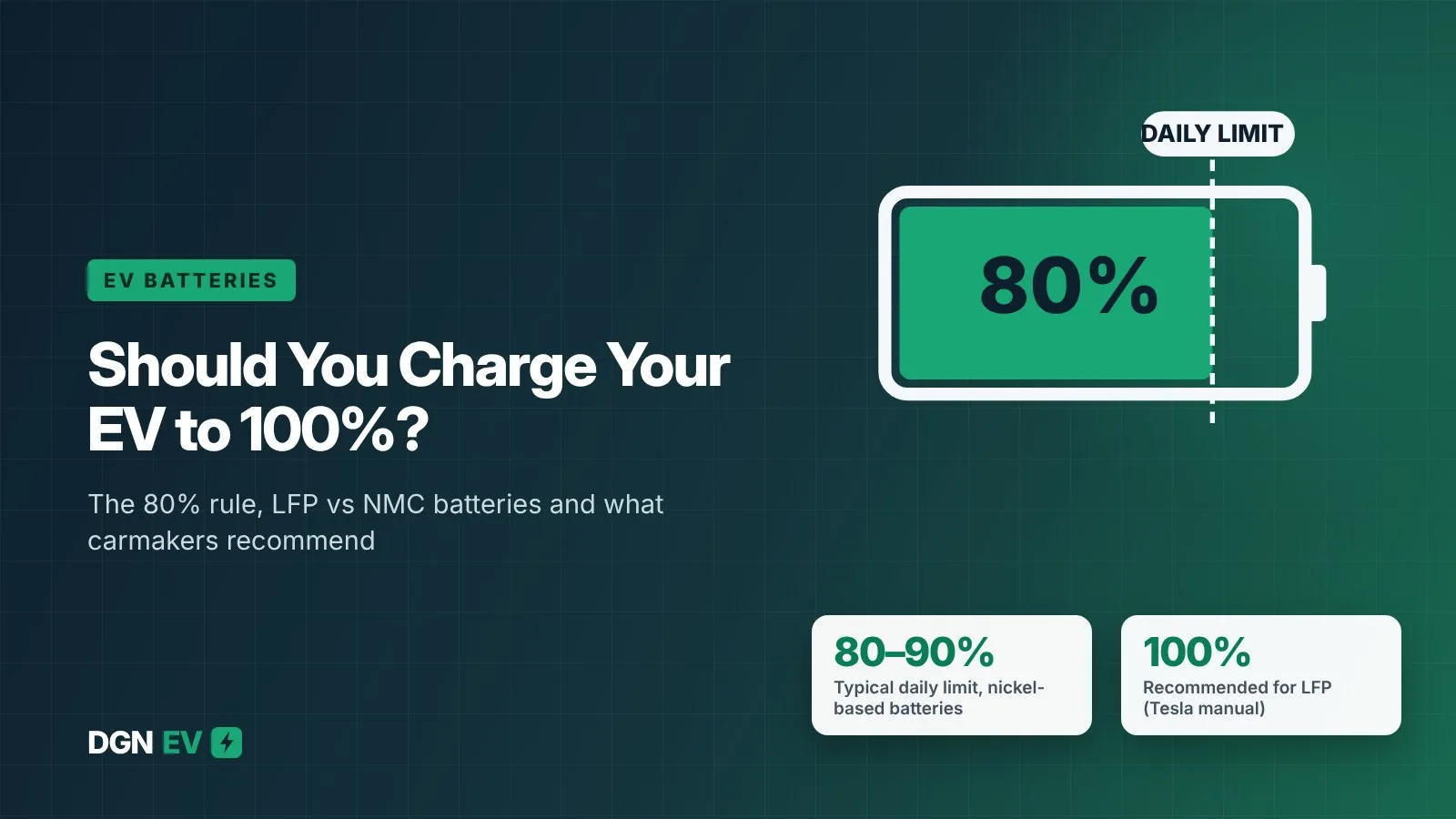
Should You Charge Your EV to 100%? What Carmakers Actually Recommend
Charging to 100% is fine before a road trip, but most EVs with nickel-based batteries last longer if you charge to around 80–90% day to day. LFP…

Electric Cars: Pros and Cons You Should Know
Electric cars are cheaper to run and maintain, but they cost more to buy and need more planning on long trips. Here are the real advantages and…
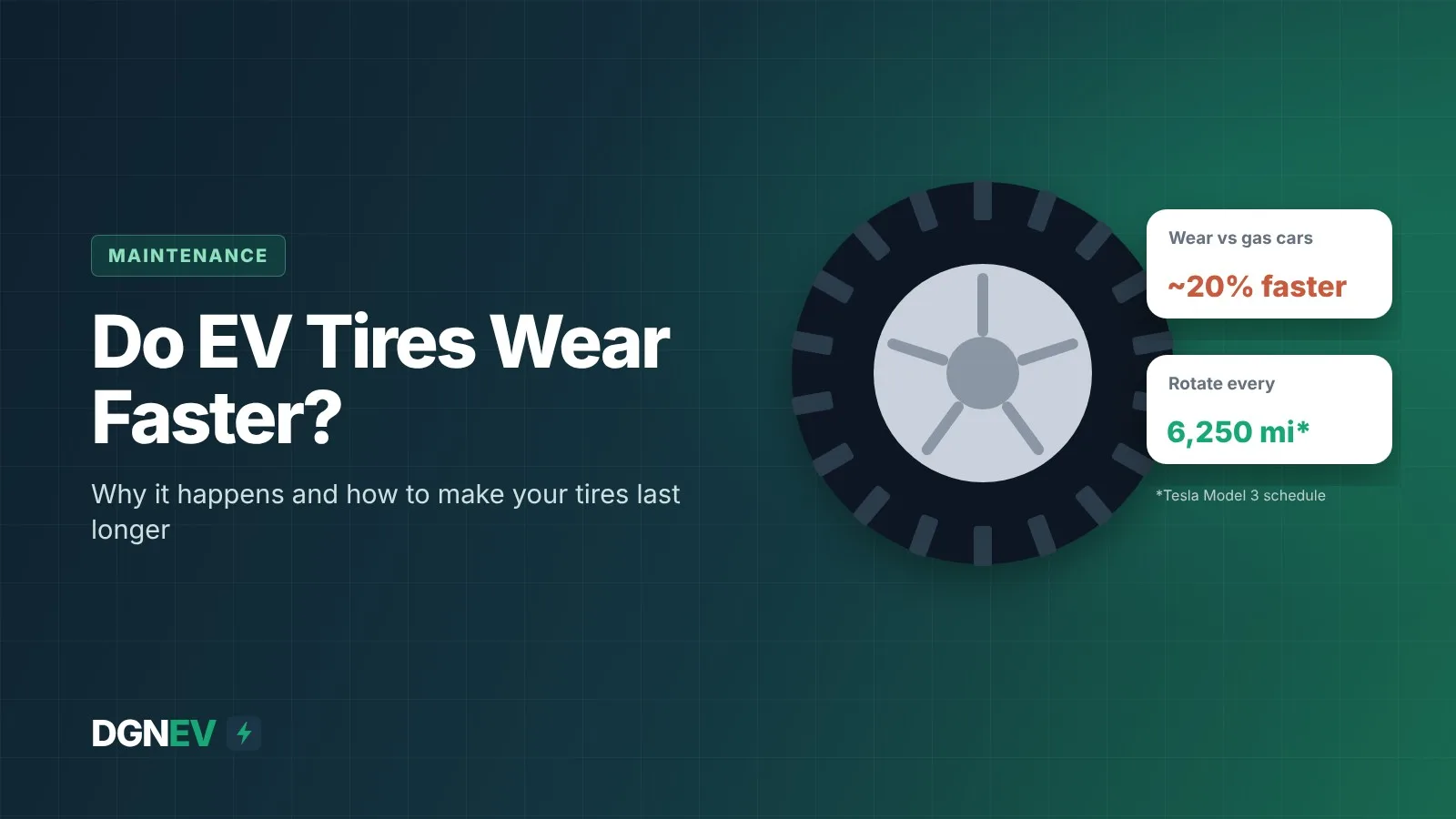
Do EV Tires Wear Faster? How to Make Them Last Longer
Tires are often the biggest regular maintenance cost of an electric car – and they can wear out faster than on a gas car. Learn why, what makes EV…
Comments
Be the first to comment
Questions and experiences are welcome. Comments are reviewed before publishing; links are not allowed. Your email is optional and never shown.