What to Know Before Buying an Electric Car: 10 Things to Check
Thinking about an EV? Check these 10 things first: where you will charge, how much range you really need, what charging costs, battery warranty, insurance, resale value and which incentives still exist in 2026.
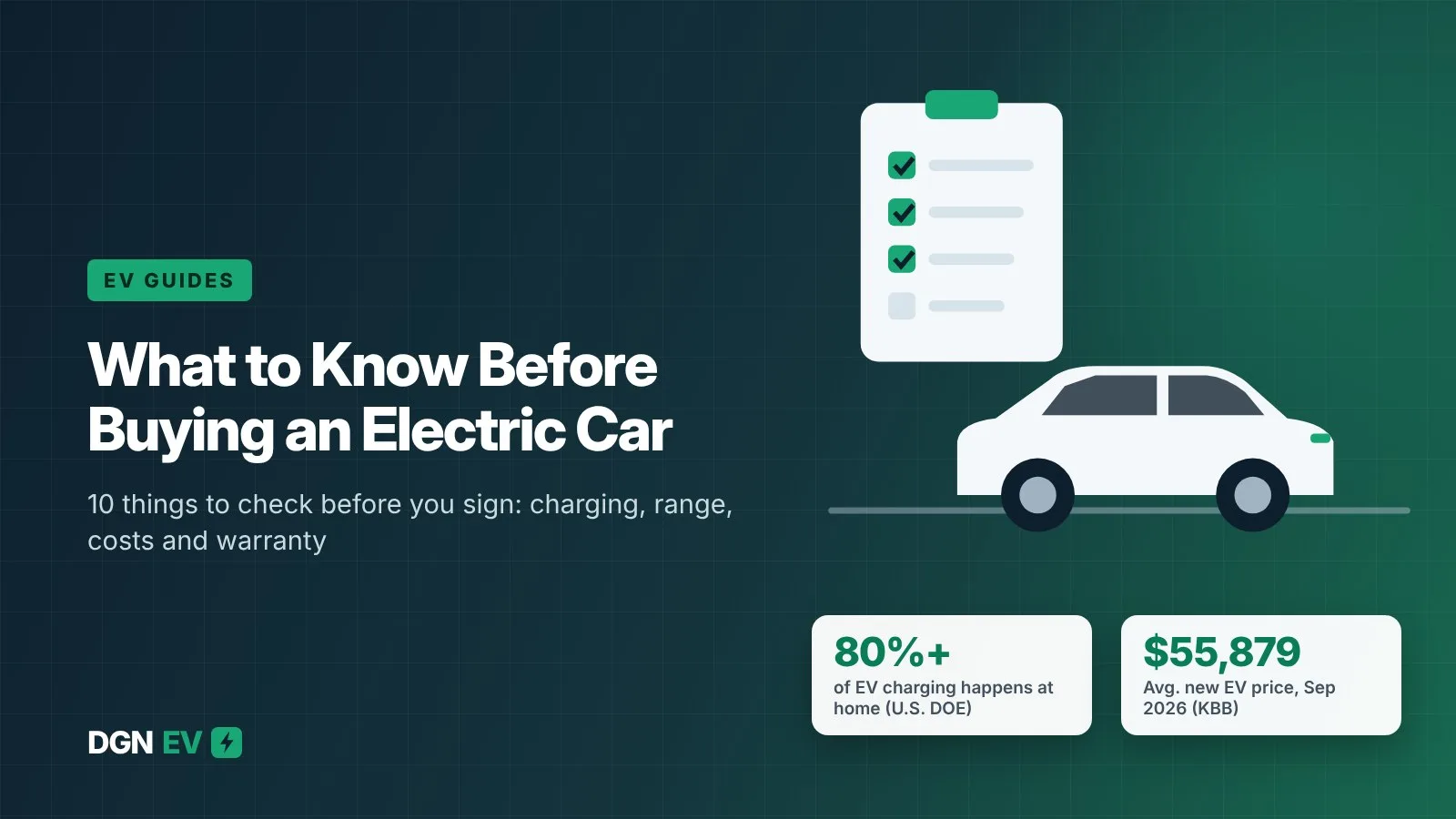
The most important thing to know before buying an electric car is where you will charge it. If you can plug in at home or at work, owning an EV is usually easy and cheap to run. If you will rely only on public chargers, it can still work, but it costs more and takes more planning. After charging, the next big questions are how much range you really need, what the car will cost to insure and how fast it will lose value.
This checklist walks you through the 10 things worth checking before you sign anything. Prices and figures below are U.S. numbers from late 2026 unless we say otherwise.
1. Where will you charge?
The U.S. Department of Energy estimates that more than 80% of EV charging happens at home, and that is where most of the savings come from. Ask yourself three questions:
- Do you have off-street parking with power nearby? A standard 120-volt outlet (Level 1) adds only about 3–5 miles of range per hour, which is enough for some short commutes.
- Can you install a Level 2 charger? A 240-volt charger adds roughly 20–30 miles per hour and refills most EVs overnight. A simple installation often costs $800–$2,000, but an electrical panel upgrade can push the total to $1,000–$5,000 or more.
- Do you rent? Ask your landlord or building manager about charging before you buy, not after.
Our guide on how to charge an electric car at home covers equipment and installation in detail.
2. How much range do you really need?
Most people overestimate it. Look at your longest regular drive (not your once-a-year road trip) and add a buffer of about 30% for cold weather, highway speeds and battery aging. If your longest normal day is 70 miles, a car with an EPA range of 250 miles leaves plenty of room.
Remember that range drops in winter and at sustained highway speeds, and towing can cut it roughly in half. Read our explainer on how towing affects EV range if you pull a trailer.
3. What will charging cost you?
At home, you pay your normal electricity rate. The U.S. average residential price was about 18.3 cents per kWh in June 2026, according to the U.S. Energy Information Administration. Public fast charging is much more expensive: AAA put the national average at about 41 cents per kWh in October 2026.
That gap matters. Charging at home typically costs less than half as much per mile as driving a similar gas car, while relying only on fast chargers can wipe out most of the fuel savings. See our full breakdown of how much it costs to charge an electric car, or plug your own numbers into our EV charging cost calculator.
4. Check the price after incentives (and what is gone)
The average transaction price of a new EV in the U.S. was about $55,879 in September 2026, according to Kelley Blue Book, compared with about $50,562 for all new vehicles. The gap has narrowed, and many carmakers now offer large discounts on EVs.
Two things changed recently in the U.S.:
- The federal tax credit of up to $7,500 for new EVs, and the used EV credit, ended on September 30, 2025.
- Some states and utilities still offer rebates, cheaper charging rates or charger installation help. Search your state energy office and your electric company's website before you buy.
In the UK and many EU countries, incentives vary widely and change often, so check your government's official website.
5. Understand the battery warranty
The battery is the most expensive part of an EV, so its warranty matters more than almost anything else. In the U.S., most carmakers cover the high-voltage battery for at least 8 years or 100,000 miles, and the coverage usually guarantees a minimum capacity (often 70%) during that period. Read the fine print on what counts as a defect.
The good news is that real-world data shows most batteries age slowly. Our article on how long EV batteries last explains what fleet data shows.
6. Get an insurance quote first
EVs often cost more to insure because they are pricier to repair. Insurify found that EV drivers paid about 42% more for full coverage than gas car drivers on average in mid-2026. The difference varies a lot by model and state, so get two or three quotes for the exact car before you commit.
7. Think about resale value
EVs have depreciated faster than gas cars in recent years, partly because of price cuts on new models and fast-moving technology. That is bad news if you buy new and sell after three years, but good news if you buy used. According to Cox Automotive, the average used EV listing price was about $36,767 in September 2026, far below new EV prices. Leasing can also protect you from depreciation risk.
8. Check the charging port and network access
In North America, most carmakers have moved to the NACS plug (also called SAE J3400) used by Tesla, which gives access to Tesla's large Supercharger network. Older EVs with a CCS1 port can often use Superchargers with an adapter. Before you buy, check:
- Which port the car has and whether an adapter is included
- Its peak DC fast-charging speed and typical 10–80% charging time
- Which charging networks are near your home and along routes you drive often
Our explainer on how long it takes to charge an electric car explains what those charging numbers mean in practice.
9. Look at the running costs beyond energy
EVs need no oil changes, spark plugs or timing belts, so routine maintenance is usually cheaper. Brake pads also tend to last longer thanks to regenerative braking (see our guide to EV brakes). On the other hand, EVs are heavy and powerful, so tires can wear faster and cost more to replace.
10. Take a proper test drive
Drive the car on roads you use every day, including the highway. Pay attention to:
- Regenerative braking and one-pedal mode: some people love it, others need a few days to adjust.
- Visibility, seats and ride comfort: heavy batteries can make the ride firm.
- Screens and controls: many EVs move most controls to a touchscreen.
- Charging: if you can, ask to try plugging in at a public charger.
Quick checklist
| Check | Why it matters |
|---|---|
| Home or workplace charging | Biggest factor in cost and convenience |
| Real range need + 30% buffer | Covers winter, highway speeds and aging |
| Your electricity rate | Decides how much you save on fuel |
| Price after incentives | Federal U.S. credits ended in 2025 |
| Battery warranty terms | Protects the most expensive part |
| Insurance quote | Can be much higher than a gas car |
| Resale value / lease option | EVs have depreciated quickly |
| Charging port and network | Affects road trips |
FAQ
Is it worth buying an electric car in 2026?
For many drivers who can charge at home, yes: running costs are lower and maintenance is simpler. If you drive long distances daily without home charging, or you tow heavy loads often, a hybrid may suit you better. Our list of electric car pros and cons can help you decide.
Can I own an EV without a home charger?
Yes, if you have reliable charging at work or a fast charger close to home. Expect higher costs per mile and more planning.
Should I buy a new or used EV?
Used EVs are much cheaper and many still have years of battery warranty left. Check the battery's health report and remaining warranty before buying.
How long does an EV battery last?
Most modern EV batteries are expected to last well over 10 years and lose only a few percent of capacity per year, according to large fleet studies.
The bottom line
Start with charging, then work out your real range needs, and only then compare models. Get an insurance quote, read the battery warranty and run the numbers on charging costs for your own electricity rate. If those check out, an EV is likely to be cheaper and easier to live with than you expect.
Work out your own numbers
Note: This guide is for general information only. Prices, specifications and regulations change over time and vary by country, so always check with the manufacturer or a qualified professional before making decisions. Read our disclaimer.
Keep reading

BEV vs PHEV vs HEV: Types of Electric Cars Explained
BEV, PHEV, HEV, MHEV, EREV – electrified cars come in several types. Learn how each one works, how far it can drive on electricity, whether you need…

Electric Cars: Pros and Cons You Should Know
Electric cars are cheaper to run and maintain, but they cost more to buy and need more planning on long trips. Here are the real advantages and…
How Do Electric Cars Work? A Simple Guide
Electric cars replace the engine and fuel tank with a battery, an inverter and an electric motor. Here is how each part works, how energy flows from…
Comments
Be the first to comment
Questions and experiences are welcome. Comments are reviewed before publishing; links are not allowed. Your email is optional and never shown.