How Do Electric Cars Work? A Simple Guide
Electric cars replace the engine and fuel tank with a battery, an inverter and an electric motor. Here is how each part works, how energy flows from the plug to the wheels, and why EVs are so efficient.
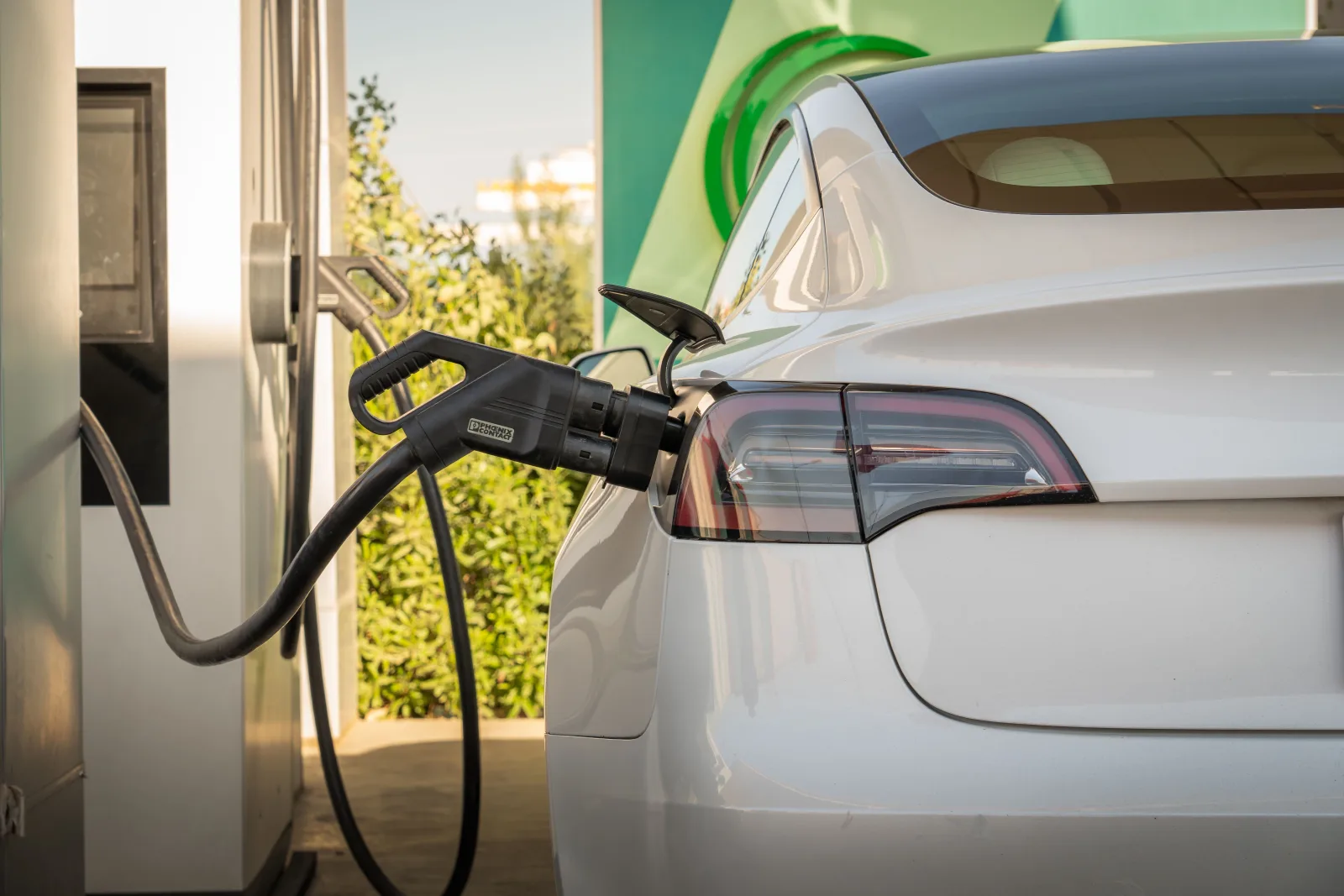
An electric car works by storing electricity in a large battery and using it to power one or more electric motors that turn the wheels. There is no engine, no fuel tank, no exhaust and no gearbox full of gears. Instead, a handful of electronic parts move energy from the battery to the motor – and, when you slow down, back into the battery again.
That simple setup is why electric vehicles (EVs) feel so smooth and quiet, need less maintenance and use energy far more efficiently than gasoline cars. In this guide, we walk through each part step by step, in plain English.
The main parts of an electric car
A battery electric vehicle has far fewer moving parts than a gasoline car. According to the U.S. Department of Energy's Alternative Fuels Data Center, these are the key components:
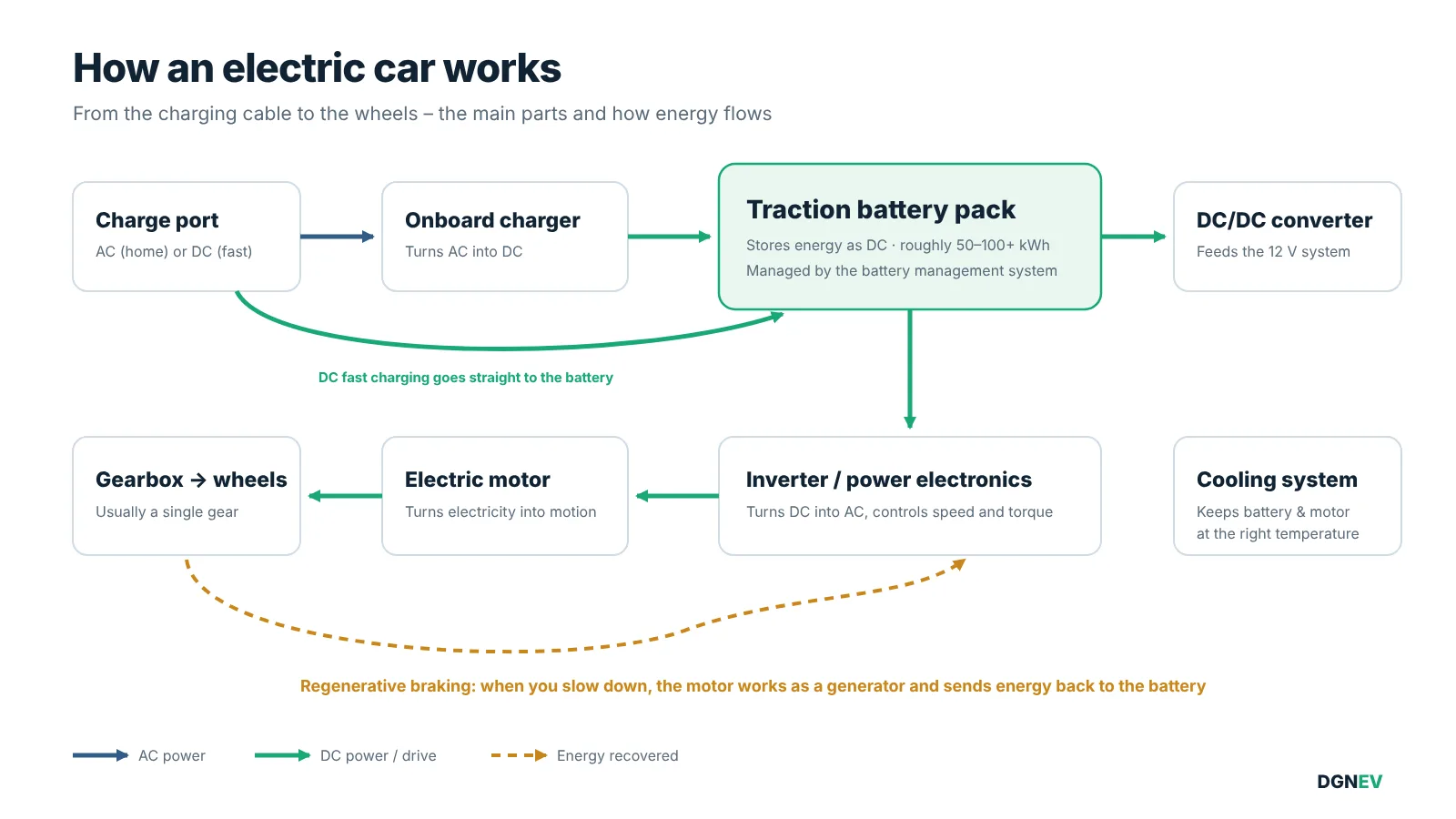
- Traction battery pack – the large, high-voltage battery that stores the energy used to drive the car. It is usually mounted flat under the floor.
- Inverter (power electronics controller) – manages the flow of energy from the battery and controls how fast the motor spins and how much torque it delivers.
- Electric traction motor – turns electrical energy into motion to drive the wheels. Some EVs have one motor; others have two or more for all-wheel drive.
- Transmission – passes power from the motor to the wheels. Most EVs use a simple single-speed gear reduction instead of a multi-gear gearbox.
- Onboard charger – converts the AC electricity from a home or public charger into DC electricity that the battery can store.
- Charge port – where you plug in the charging cable.
- DC/DC converter – steps the battery's high voltage down to power lights, screens, wipers and other accessories, and keeps the small 12-volt auxiliary battery charged.
- Thermal management system – heats or cools the battery, motor and electronics to keep them at the right temperature.
Step by step: from the plug to the wheels
1. Charging: getting energy into the battery
When you plug in at home or at a regular public charger, the car receives alternating current (AC). Batteries can only store direct current (DC), so the onboard charger converts AC to DC before it reaches the battery.
At a DC fast charger, the conversion happens inside the charging station instead. The charger sends DC power straight to the battery, bypassing the onboard charger. This is why DC fast charging is so much quicker.
2. Storing energy: the battery pack
The traction battery is made of hundreds or thousands of individual lithium-ion cells grouped into modules. Battery size is measured in kilowatt-hours (kWh) – think of it as the size of the "fuel tank." Most new EVs have batteries somewhere between about 50 and 100+ kWh. Industry data from Recurrent shows the average battery in 2025 model-year EVs was around 93 kWh.
A battery management system (BMS) constantly monitors every cell's temperature, voltage and state of charge. It protects the battery from overcharging, overheating and deep discharge, which is a big reason modern EV batteries last so long.
3. Converting power: the inverter
The battery supplies DC power, but most EV motors run on AC. The inverter converts DC into AC and precisely controls its frequency and strength. When you press the accelerator, you are really telling the inverter how much power to send to the motor. This happens thousands of times per second, which is why EV acceleration feels so instant and smooth.
4. Creating motion: the electric motor
Inside the motor, electricity creates rotating magnetic fields that spin the rotor. Unlike a gasoline engine, an electric motor delivers its full torque from zero rpm. That is why even ordinary family EVs pull away from a standstill so quickly.
Because electric motors work efficiently across a very wide speed range, most EVs need only a single gear. There are no gear changes, no clutch and no engine revving.
5. Getting energy back: regenerative braking
When you lift off the accelerator or press the brake, the motor runs in reverse and acts as a generator. It slows the car down while turning its movement back into electricity, which goes back into the battery. This is called regenerative braking.
According to the U.S. Department of Energy, regenerative braking recovers about 22% of the energy used on the standard EPA combined city and highway test cycle. Many EVs also offer one-pedal driving: the car slows down strongly as soon as you lift your foot, so you rarely need the brake pedal in town. The regular friction brakes are still there for hard stops.
Why electric cars are so efficient
A gasoline engine wastes most of its fuel's energy as heat. Electric drivetrains waste very little. The U.S. Department of Energy reports that a typical EV is 87–91% efficient, compared to about 30% for a conventional gasoline vehicle.
| Electric car | Gasoline car | |
|---|---|---|
| Energy source | Battery (electricity) | Fuel tank (gasoline) |
| What turns the wheels | Electric motor | Internal combustion engine |
| Typical efficiency | 87–91% | About 30% |
| Gears | Usually 1 | 6–10 in modern automatics |
| Recovers energy when braking | Yes | No |
| Oil changes | Not needed | Every few thousand miles |
| Tailpipe emissions | None | Yes |
This efficiency is a big reason why driving on electricity usually costs less per mile than driving on gasoline – although the exact savings depend on local electricity and fuel prices.
What about range and charging time?
Range is how far an EV can drive on a full battery. It depends mainly on battery size and efficiency, but also on speed, temperature, terrain and the use of heating or air conditioning. The U.S. Department of Energy's FuelEconomy.gov notes that most EVs can travel more than 100 miles (160 km) on a charge and some exceed 400 miles (640 km). Recurrent's data shows that the average EPA-rated range of 2025 model-year EVs was about 293 miles (470 km).
Charging time depends on the charger and the battery size:
- Level 1 (standard household outlet): very slow, mainly useful for overnight top-ups or plug-in hybrids.
- Level 2 (home wall box or public AC charger): the most common way to charge. A full charge usually takes several hours, so overnight charging covers most people's daily driving.
- DC fast charging: according to FuelEconomy.gov, a fast charge to 80% can take about 30 minutes, depending on the car and the charger.
Electric cars vs hybrids: what's the difference?
Not every "electrified" car works the same way:
- Battery electric vehicles (BEVs) run only on electricity. Everything in this guide applies to them.
- Plug-in hybrids (PHEVs) have a smaller battery and an electric motor for shorter trips, plus a gasoline engine for longer journeys.
- Hybrids (HEVs) cannot be plugged in. Their small battery is charged by the engine and by regenerative braking, and it mainly helps the engine use less fuel.
Frequently asked questions
Do electric cars have a transmission?
Most EVs have a single-speed transmission (a simple reduction gear) rather than a multi-gear gearbox. A few high-performance models use two gears.
Do electric cars need oil changes?
No. EVs have no engine oil to change. They still need regular checks of tires, brakes, cabin air filters, coolant and washer fluid. Thanks to regenerative braking, their brake pads often last longer.
What happens when the battery runs low?
The car warns you well before the battery is empty and usually limits power to save energy. If the battery does run out completely, the car will stop and must be towed or charged on the spot, so it is best to plan charging stops in advance.
Do electric cars still have a 12-volt battery?
Yes. Most EVs have a small 12-volt auxiliary battery that powers the computers, locks, lights and other accessories. The DC/DC converter keeps it charged from the main battery.
Are electric cars safe in the rain or a car wash?
Yes. High-voltage parts are sealed and tested to work in rain, snow and automatic car washes. Charging in the rain is also safe with standard, undamaged equipment.
The bottom line
An electric car is surprisingly simple: a battery stores energy, an inverter controls it, and an electric motor turns it into motion – then recovers some of it when you slow down. Fewer moving parts mean smoother driving, less maintenance and much higher efficiency than a gasoline car.
Now that you know how EVs work, the next step is understanding the details that matter for everyday ownership, such as battery life, charging at home and real-world range. We cover each of these in our other guides.
Sources and further reading
- U.S. Department of Energy's Alternative Fuels Data Center – afdc.energy.gov
- Recurrent – recurrentauto.com
- U.S. Department of Energy – energy.gov
- FuelEconomy.gov – fueleconomy.gov
Work out your own numbers
Note: This guide is for general information only. Prices, specifications and regulations change over time and vary by country, so always check with the manufacturer or a qualified professional before making decisions. Read our disclaimer.
Keep reading
What to Know Before Buying an Electric Car: 10 Things to Check
Thinking about an EV? Check these 10 things first: where you will charge, how much range you really need, what charging costs, battery warranty…

BEV vs PHEV vs HEV: Types of Electric Cars Explained
BEV, PHEV, HEV, MHEV, EREV – electrified cars come in several types. Learn how each one works, how far it can drive on electricity, whether you need…

Electric Cars: Pros and Cons You Should Know
Electric cars are cheaper to run and maintain, but they cost more to buy and need more planning on long trips. Here are the real advantages and…
Comments
Be the first to comment
Questions and experiences are welcome. Comments are reviewed before publishing; links are not allowed. Your email is optional and never shown.