BEV vs PHEV vs HEV: Types of Electric Cars Explained
BEV, PHEV, HEV, MHEV, EREV – electrified cars come in several types. Learn how each one works, how far it can drive on electricity, whether you need to plug it in and which type suits your driving best.

Not every "electric car" is the same. A BEV (battery electric vehicle) runs only on electricity from a battery you plug in. A PHEV (plug-in hybrid) has a plug-in battery for shorter trips plus a gasoline engine. An HEV (hybrid electric vehicle) has a small battery that charges itself and helps a gasoline engine use less fuel – you never plug it in.
These labels matter, because they change how far you can drive on electricity, how much you spend on fuel and whether you need a charger at home. This guide explains every type in plain English and helps you work out which one fits your life.
For a look at the technology inside a fully electric car, see our guide on how electric cars work.
The main types at a glance
| Type | Plug in? | Gas engine? | Typical battery | Electric-only driving |
|---|---|---|---|---|
| BEV – battery electric | Yes | No | About 50–100+ kWh | All driving – typically 200–350+ miles (320–560+ km) per charge |
| PHEV – plug-in hybrid | Yes | Yes | About 10–25 kWh | Short trips – often 25–50 miles (40–80 km) |
| HEV – full hybrid | No | Yes | About 1–2 kWh | Very short distances at low speed |
| MHEV – mild hybrid | No | Yes | Under 1 kWh | None – it only assists the engine |
| EREV – range extender | Yes | Yes, as a generator only | About 20–45 kWh | Most daily driving; engine recharges the battery on long trips |
Figures are typical ranges for current models; individual cars vary.
BEV: battery electric vehicle
A BEV is what most people mean by an "electric car". It has no gasoline engine at all – just a large battery, one or more electric motors and a charging port. Examples include the Tesla Model 3, Hyundai Ioniq 5, Chevrolet Equinox EV and Volkswagen ID.4.
- Pros: no gasoline, no tailpipe emissions, lowest running and maintenance costs, quiet and quick acceleration.
- Cons: usually the highest purchase price, long trips need charging stops, and you really want a place to charge at home or work.
- Best for: drivers who can charge at home and mostly drive within the car's range.
PHEV: plug-in hybrid electric vehicle
A PHEV combines a mid-sized battery that you charge from an outlet with a gasoline engine. On a full battery, it drives on electricity for short trips; when the battery runs low, it works like a regular hybrid. Examples include the Toyota RAV4 Plug-in Hybrid, Jeep Wrangler 4xe and BMW X5 xDrive50e.
- Pros: electric commuting with no range worries on long trips.
- Cons: you maintain both an engine and an electric system, and the savings depend entirely on plugging in regularly.
- Best for: drivers with short daily commutes who can charge at home but regularly make long trips.
The catch: many PHEVs are not charged as often as official tests assume. A 2026 study by the International Council on Clean Transportation (ICCT) of about 920,000 plug-in hybrids in Europe found that cars registered in 2023 emitted about 4.6 times more CO₂ in real-world use than their official figures, because they were driven on gasoline far more than expected. A PHEV that is rarely plugged in is just a heavier hybrid.
HEV: hybrid electric vehicle
A full hybrid, like the Toyota Prius or Honda CR-V Hybrid, has a gasoline engine plus an electric motor and a small battery. The battery charges itself through regenerative braking and the engine, so you never plug it in. The electric motor helps at low speeds and when accelerating, which cuts fuel use, especially in city driving.
- Pros: better fuel economy than a regular gas car, no change in habits, lower price than a BEV.
- Cons: still runs on gasoline and produces tailpipe emissions.
- Best for: drivers who cannot charge at home or want a simple, efficient car.
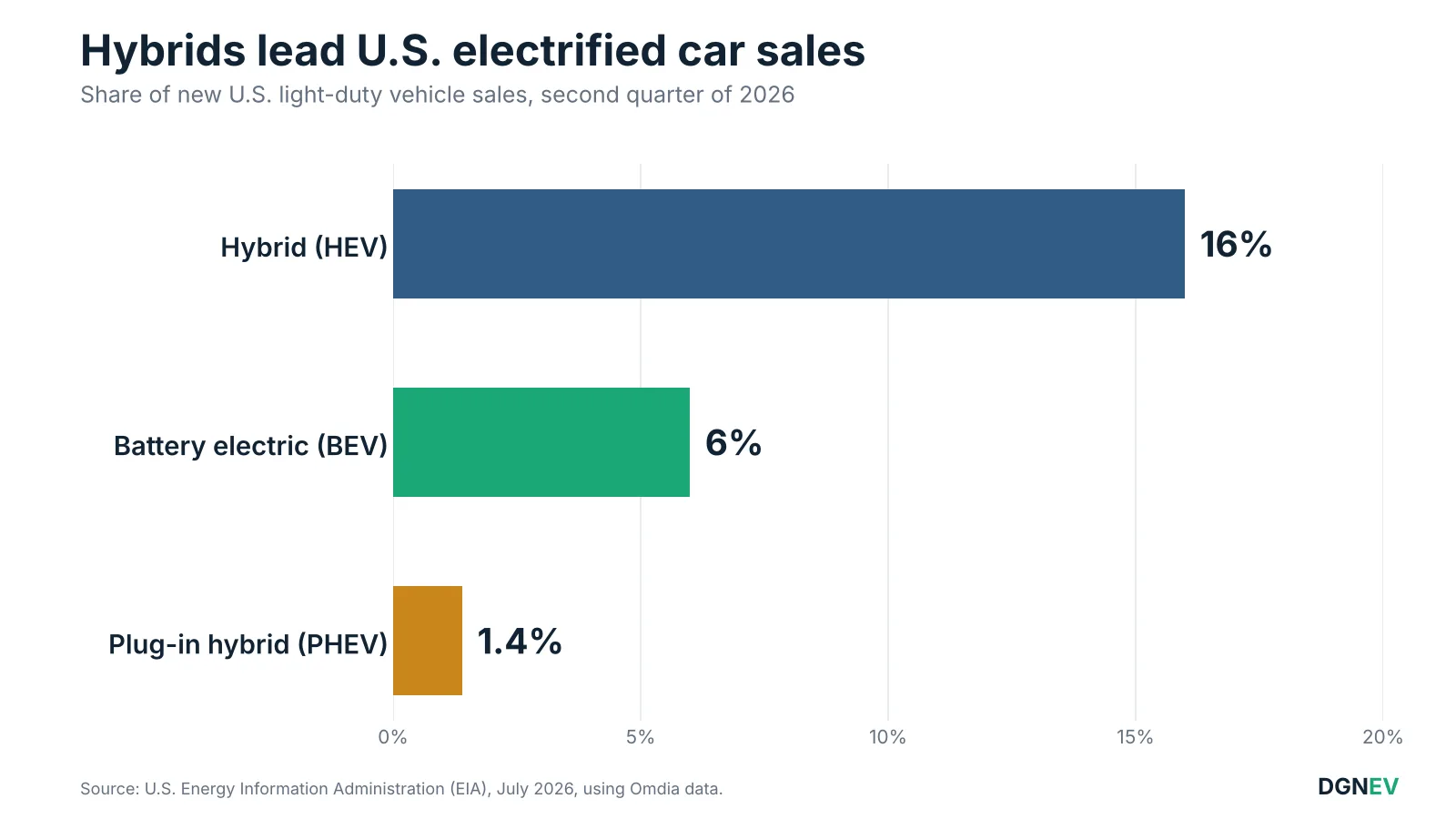
Hybrids are booming: in the U.S., they reached a record 16% of new light-duty vehicle sales in the second quarter of 2026, according to the U.S. Energy Information Administration (EIA).
MHEV: mild hybrid
A mild hybrid uses a small 48-volt battery and a starter-generator to support the engine – smoothing stop-start, recovering some braking energy and adding a little boost. It cannot drive on electricity alone. Mild hybrids save some fuel, but far less than full hybrids; think of them as a more efficient gas car rather than an electric one.
EREV: extended-range electric vehicle
An EREV, or range extender, is driven by electric motors at all times, like a BEV. It has a gasoline engine too, but the engine only works as a generator to recharge the battery – it does not turn the wheels. EREVs are popular in China, and several carmakers have announced range-extender models for North America and Europe, especially pickups and large SUVs. They offer BEV-like driving with gasoline backup for long trips.
Which type is right for you?
- Can you charge at home or work? If yes, a BEV or PHEV makes sense. If not, a hybrid is usually the easiest and cheapest choice.
- How far do you drive each day? If most days are under 30–40 miles, a PHEV can do them on electricity; a BEV covers far more.
- How often do you take long trips? Frequent long trips in areas with few fast chargers can favor a hybrid, PHEV or EREV.
- What is your budget? Hybrids usually cost least to buy; BEVs usually cost least to run. Compare the numbers in our guide on which is cheaper, electric or gas.
Frequently asked questions
Is a hybrid an electric car?
A hybrid is an electrified car, but not an electric car in the full sense. It always runs on gasoline and uses its small battery and motor to save fuel. Only BEVs run entirely on electricity.
Do you have to plug in a hybrid?
No. A regular hybrid (HEV) and a mild hybrid charge themselves. Only plug-in hybrids (PHEVs), range extenders (EREVs) and battery electric cars (BEVs) need to be plugged in.
What happens if you never charge a plug-in hybrid?
It will still drive using the gasoline engine, but you lose most of the benefit. You carry the weight of a large battery without using it, so fuel economy can be worse than a regular hybrid.
Is a PHEV better than a BEV?
Neither is better for everyone. A BEV has lower running costs and no tailpipe emissions; a PHEV removes range worries but only saves fuel if you charge it often. Your charging options and driving patterns decide.
What does "electrified vehicle" mean?
It is an umbrella term for any vehicle that uses an electric motor for propulsion, including mild hybrids, full hybrids, plug-in hybrids, range extenders and battery electric cars.
The bottom line
BEVs run only on electricity, PHEVs and EREVs mix a plug-in battery with gasoline backup, and hybrids use a small self-charging battery to save fuel. If you can charge at home, a BEV usually offers the lowest running costs; if you cannot, a hybrid is a simple way to cut fuel use. Choose based on where you can charge and how you actually drive.
Weighing up a fully electric car? Read our balanced guide to the pros and cons of electric cars.
Work out your own numbers
Note: This guide is for general information only. Prices, specifications and regulations change over time and vary by country, so always check with the manufacturer or a qualified professional before making decisions. Read our disclaimer.
Keep reading
What to Know Before Buying an Electric Car: 10 Things to Check
Thinking about an EV? Check these 10 things first: where you will charge, how much range you really need, what charging costs, battery warranty…

Electric Cars: Pros and Cons You Should Know
Electric cars are cheaper to run and maintain, but they cost more to buy and need more planning on long trips. Here are the real advantages and…
How Do Electric Cars Work? A Simple Guide
Electric cars replace the engine and fuel tank with a battery, an inverter and an electric motor. Here is how each part works, how energy flows from…
Comments
Be the first to comment
Questions and experiences are welcome. Comments are reviewed before publishing; links are not allowed. Your email is optional and never shown.