How Long Does It Take to Charge an Electric Car?
Charging an EV takes anywhere from about 20 minutes to more than 40 hours. It depends on the charger, the battery size and the car's own charging limit. Here are real-world times for Level 1, Level 2 and DC fast charging.
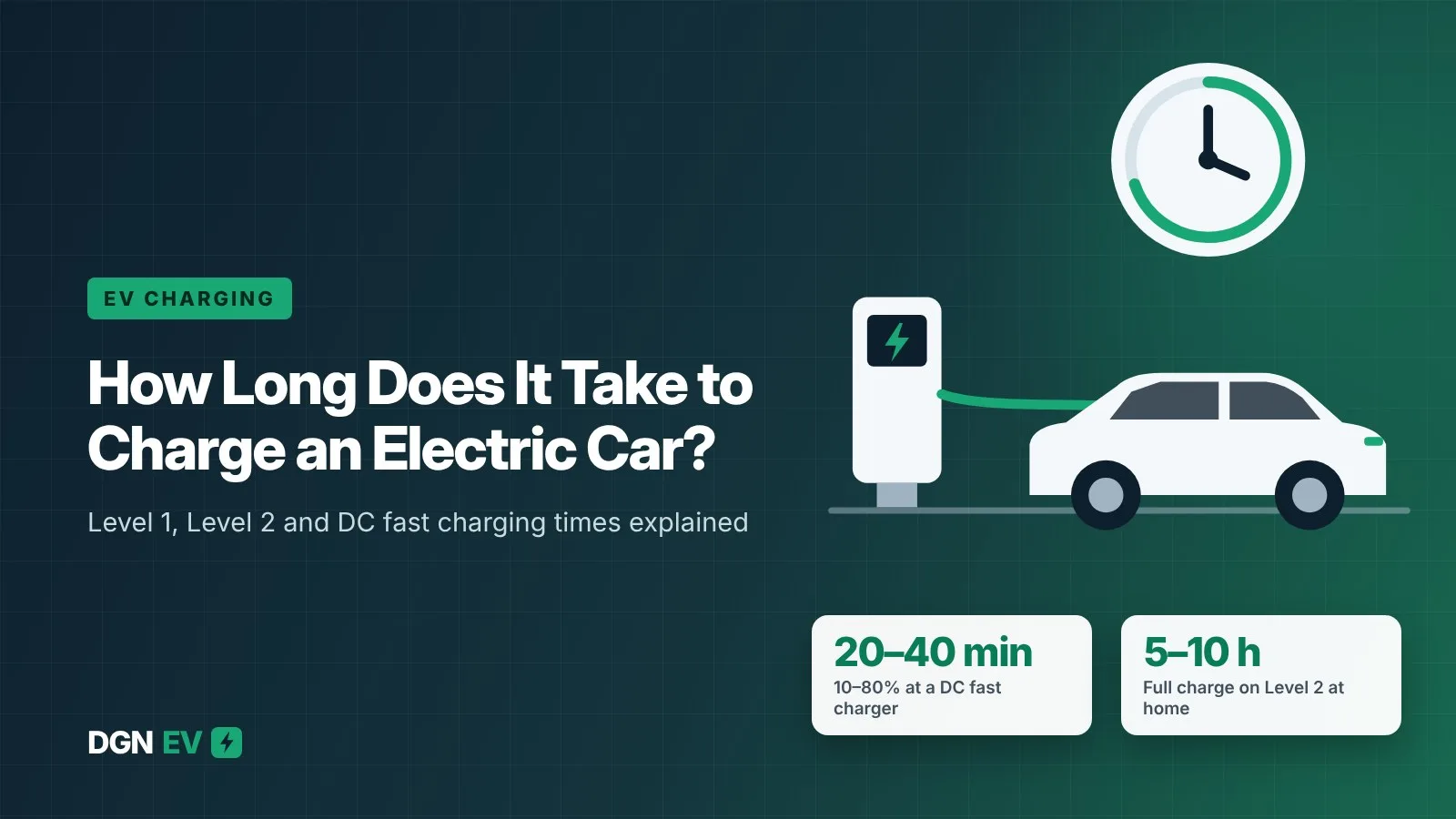
It takes about 20 to 40 minutes to charge a typical electric car from 10% to 80% at a DC fast charger, 5 to 10 hours to charge it fully on a Level 2 home charger, and two days or more from a standard household outlet. The exact time depends on three things: the power of the charger, the size of the battery and the maximum charging speed the car itself can accept.
Charging times at a glance
The table below uses a mid-size EV with a 60 kWh usable battery as an example. Times are estimates that include typical charging losses.
| Charger | Typical power | Range added per hour | 10–80% | 0–100% |
|---|---|---|---|---|
| Level 1 (120 V outlet) | 1.2–1.9 kW | About 3–5 miles | About 30+ hours | About 40–50 hours |
| Level 2 (240 V), 7 kW | 6.6–7.7 kW | About 20–30 miles | About 6–7 hours | About 9 hours |
| Level 2 (240 V), 11 kW | 11–11.5 kW | About 35–45 miles | About 4 hours | About 6 hours |
| DC fast charging | 50–350 kW | Hundreds of miles | About 20–40 minutes | Not practical (slows above 80%) |
In the UK and Europe, the same categories apply, but home charging uses 230 V: a typical home wall box delivers 7 kW (single phase) or up to 11–22 kW where three-phase power is available.
The simple formula
For AC charging (Level 1 and Level 2), you can estimate the time yourself:
Charging time (hours) = energy needed (kWh) ÷ charging power (kW), then add about 10% for losses.
Example: your car's battery is at 20% and you want 80% of a 75 kWh battery. That is 60% × 75 = 45 kWh. On a 7.2 kW charger: 45 ÷ 7.2 = 6.25 hours, plus about 10%, so roughly 7 hours. Our EV charging time calculator does this for you in miles or kilometers.
What limits charging speed
The charger
A charger can only deliver what it is rated for. A 7 kW wall box will never charge faster than 7 kW, even if your car could accept more.
The car's onboard charger (AC)
For Level 1 and Level 2, the car converts AC power to DC with its own onboard charger. If that charger is rated at 7.2 kW, plugging into an 11.5 kW wall box will not help. Many recent EVs accept around 11 kW, and some trucks accept more.
The car's DC charging limit and charging curve
At a DC fast charger, power goes straight to the battery, and the car's battery management system decides how much it will take. Charging is fastest when the battery is low and slows down as it fills, especially above 80%. This is why fast-charging times are usually quoted from 10% to 80%. Read more in our guide to charging at home and our explainer on whether you should charge to 100%.
Temperature
A cold battery charges much more slowly. Many EVs can precondition (warm) the battery while you drive to a fast charger if you set the charger as your navigation destination. In winter, expect slower sessions, especially if you skip preconditioning.
Real-world fast-charging examples
- Hyundai Ioniq 5: Hyundai quotes about 18 minutes from 10% to 80% on a high-power charger, thanks to its 800-volt system.
- Tesla Model Y: Tesla lists about 144–182 miles of range added in 15 minutes at a Supercharger, depending on the version. See our Tesla Model Y guide.
- Older or budget EVs: some models peak at 50–100 kW and need 40 minutes or more for the same 10–80% charge.
The fastest car on paper is not always fastest in practice. A car that holds a high power level for longer can beat one with a higher peak that drops off quickly.
How to charge faster
- Arrive with a low battery (10–20%) at a fast charger, when charging is quickest.
- Stop at 70–80% on road trips and continue; the last 20% is slow.
- Precondition the battery in cold weather by navigating to the charger.
- Pick a charger that matches your car. A 350 kW charger will not speed up a car that peaks at 100 kW, though it will not hurt either.
- At home, install Level 2. It turns overnight charging from "partial" to "full" for almost every driver.
How long does a full charge take at home?
Most drivers do not charge from empty to full. If you drive 40 miles a day, you need to replace about 12–14 kWh, which takes about 2 hours on a 7 kW Level 2 charger, or about 10 hours on a standard outlet. That is why Level 1 can work for short commutes, while Level 2 covers almost everyone.
FAQ
How long does it take to charge an EV at a Tesla Supercharger?
Usually 15–30 minutes for a meaningful top-up. Tesla says a Model Y can add up to about 182 miles in 15 minutes, depending on the version and conditions.
Can I charge an electric car in 5 minutes?
Not most cars sold in the U.S. or Europe today. Some Chinese systems, such as BYD's megawatt "Flash" charging, are designed for charging times close to refueling, but they need special cars and chargers.
Why does my EV charge slower in winter?
Lithium-ion batteries accept charge more slowly when cold to protect the cells. Preconditioning the battery before a fast-charging stop helps a lot.
Is it OK to charge my EV every night?
Yes. Plugging in overnight is normal. Set a daily charge limit if your manual recommends one.
The bottom line
For daily driving, charging time rarely matters because you charge while you sleep. It matters on road trips, where the key numbers are your car's 10–80% fast-charging time and how far that charge gets you. Check both before you buy, and use a Level 2 charger at home if you can.
Work out your own numbers
Note: This guide is for general information only. Prices, specifications and regulations change over time and vary by country, so always check with the manufacturer or a qualified professional before making decisions. Read our disclaimer.
Keep reading
How to Charge an Electric Car at Home: A Complete Guide
Charging at home is the cheapest and easiest way to run an EV. Learn the difference between Level 1 and Level 2 charging, what a home charger costs…

Electric Cars: Pros and Cons You Should Know
Electric cars are cheaper to run and maintain, but they cost more to buy and need more planning on long trips. Here are the real advantages and…
Do EV Tires Wear Faster? How to Make Them Last Longer
Tires are often the biggest regular maintenance cost of an electric car – and they can wear out faster than on a gas car. Learn why, what makes EV…
Comments
Be the first to comment
Questions and experiences are welcome. Comments are reviewed before publishing; links are not allowed. Your email is optional and never shown.