How to Charge an Electric Car at Home: A Complete Guide
Charging at home is the cheapest and easiest way to run an EV. Learn the difference between Level 1 and Level 2 charging, what a home charger costs to install, how much it adds to your electricity bill and how to do it safely.
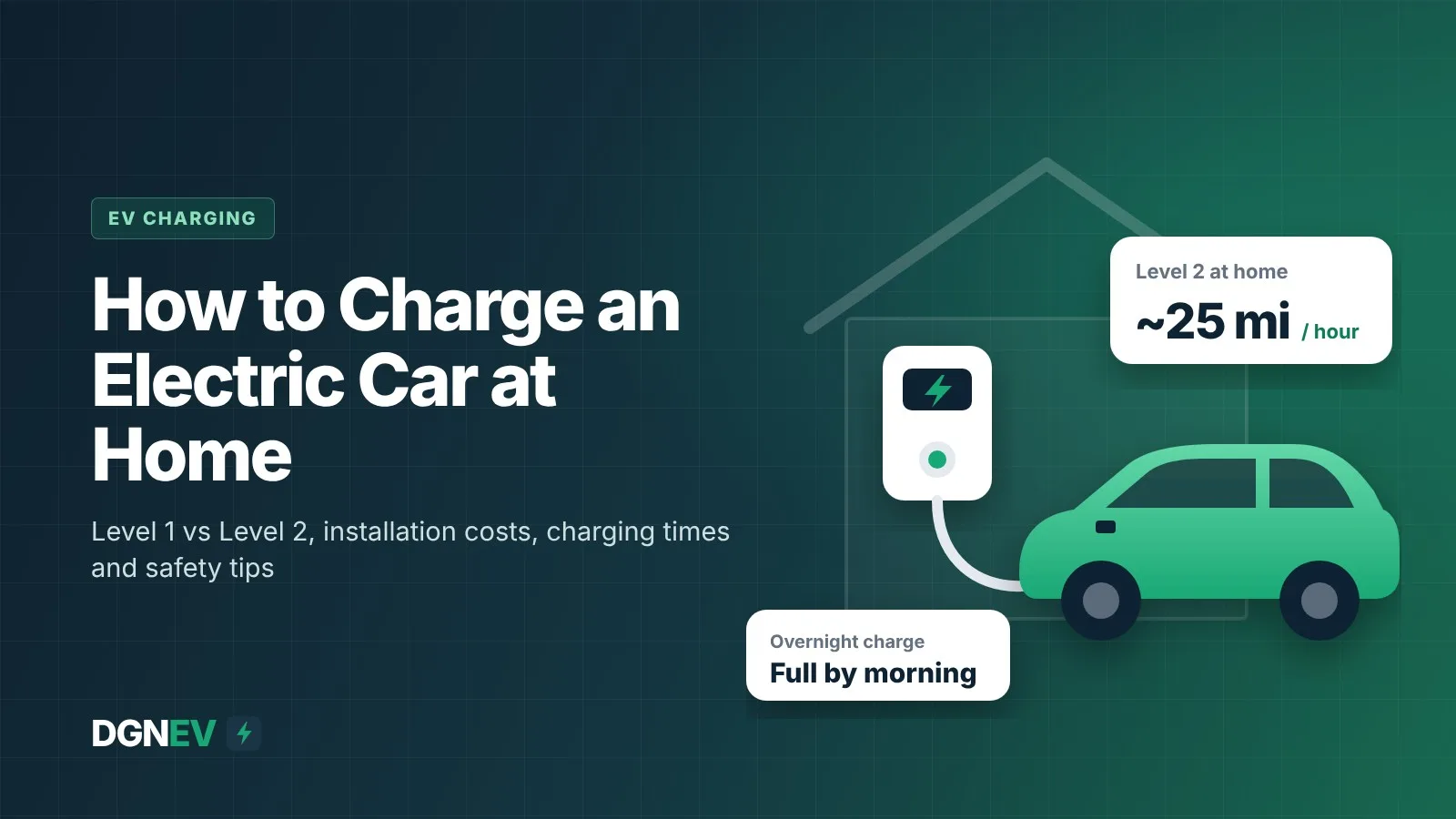
Charging an electric car at home is simple: you plug the car into a standard household outlet (Level 1) or into a dedicated 240-volt home charger (Level 2), usually overnight. Most drivers wake up to a car with enough range for the day, without ever visiting a charging station.
Home charging is also the cheapest way to fuel an EV. This guide explains your options, how long charging takes, what a home charger costs to install, how much it adds to your electricity bill and how to charge safely.
New to electric cars? Our guide on how electric cars work explains why EVs charge with AC at home and DC on fast chargers.
Your home charging options at a glance
| Level 1 | Level 2 | |
|---|---|---|
| What you plug into | Standard household outlet (120 V in North America) | 240 V wall charger or heavy-duty 240 V outlet |
| Typical power | About 1.4–1.9 kW | About 6.6–11.5 kW |
| Range added per hour | About 5 miles (8 km) | About 25 miles (40 km) at 6.6 kW |
| Range added in 10 hours overnight | About 50 miles (80 km) | About 250 miles (400 km) |
| Installation needed | Usually none | Yes – by a licensed electrician |
| Best for | Short commutes, plug-in hybrids | Most EV owners |
Range-per-hour figures are estimates from the U.S. Environmental Protection Agency (EPA), based on 1.9 kW for Level 1 and 6.6 kW for Level 2. Your car's efficiency and the weather will change the real numbers.
Level 1: charging from a regular outlet
Most EVs sold in North America come with a portable cord that plugs into a normal 120-volt outlet. It is slow – about 5 miles of range per hour, according to the EPA – but it needs no installation at all.
The EPA notes that many drivers with commutes of under 40 miles a day find Level 1 charging overnight is enough. It also works well for plug-in hybrids with small batteries. If you drive more, live somewhere cold or need to recover a big drop in charge quickly, it will feel too slow.
Outside North America, household outlets are usually 230 volts, so a portable cord on a regular socket typically delivers around 2.3 kW – a bit faster, but still slow compared with a wall box. Manufacturers often recommend using a dedicated circuit for long sessions.
Level 2: the best choice for most drivers
A Level 2 charger, often called a wall box or home charging station, runs on 240 volts – the same type of circuit used by an electric dryer or oven. At 6.6 kW, the EPA estimates it adds about 25 miles of range per hour, which is enough to fill most EVs overnight.
The figure below shows the difference over a typical 10-hour overnight session.
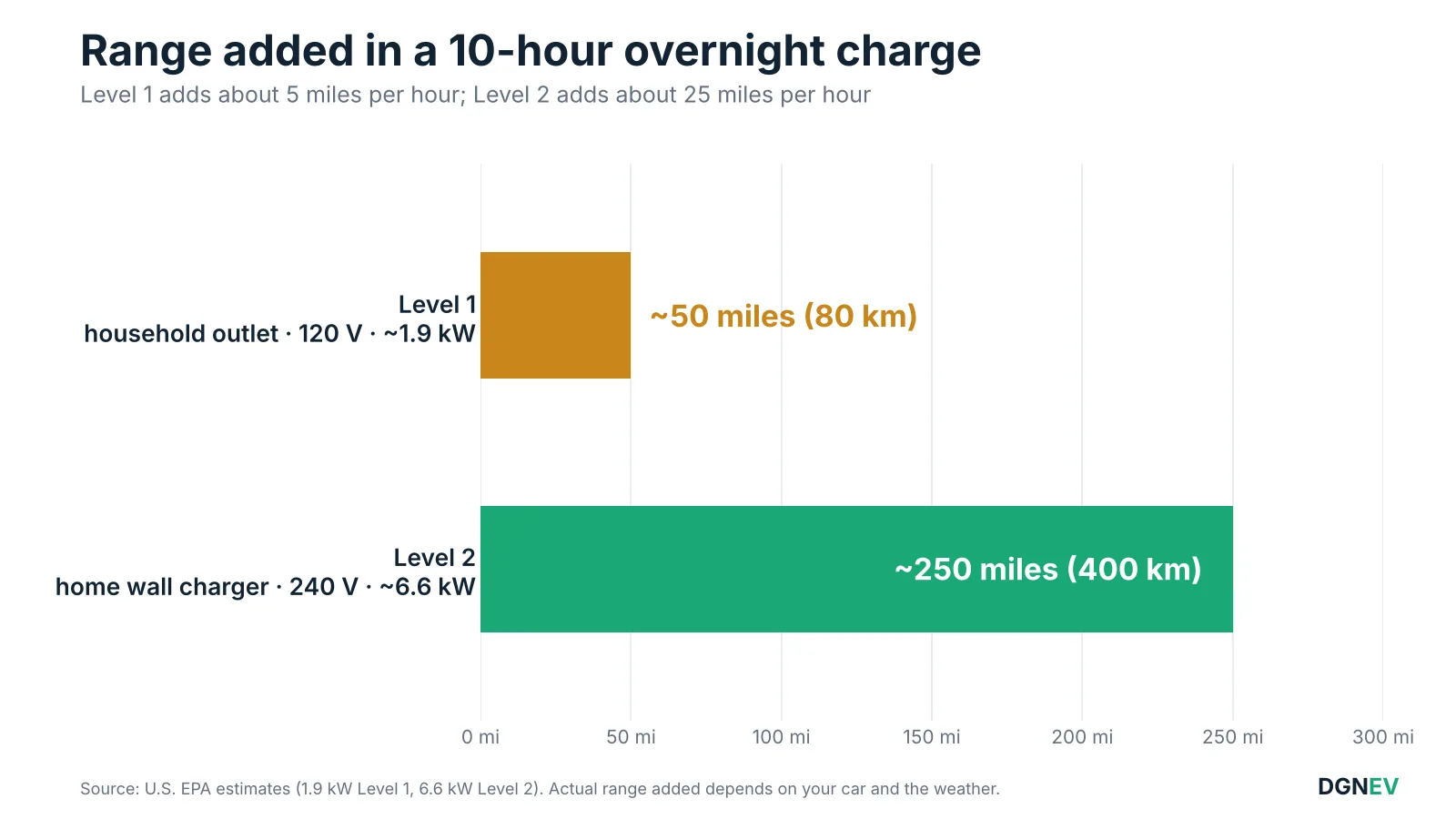
How fast your car actually charges depends on the lowest of three limits: the charger's power, the circuit it is connected to and your car's onboard charger. Many EVs accept 7–11 kW on AC; if your car's limit is 7.4 kW, buying an 11 kW charger will not make it faster. You can try different combinations with our EV charging time calculator.
How much does a home EV charger cost?
Costs vary a lot depending on your home's electrical system and where you want the charger. As a rough guide for the U.S. in 2026, based on installer pricing published by Jouleio:
- Charger hardware: about $420–$700 for a quality 48-amp unit.
- Simple installation (panel has spare capacity, short cable run): a total of roughly $800–$2,000 including the charger.
- Electrical panel upgrade (for example from 100 A to 200 A): about $1,000–$5,000 extra – the biggest variable.
- Complex installations (long cable runs, detached garage, trenching): roughly $2,000–$6,000.
Always get an itemized quote from a licensed electrician who has seen your home. Many electric utilities offer rebates or special EV rates, so check with yours before you buy.
How to get a home charger installed: step by step
- Check your car's AC charging limit. Look up its onboard charger rating (for example 7.4 kW or 11 kW) so you do not pay for power the car cannot use.
- Choose the location. Pick a spot close to where you park, with the charge port in reach of the cable. Shorter cable runs from your electrical panel usually cost less.
- Get a licensed electrician to assess your panel. They will check whether your service has enough spare capacity for a dedicated circuit, often 40–60 amps, and whether a load management device or panel upgrade is needed.
- Choose hardwired or plug-in. A hardwired charger is connected directly to the circuit. A plug-in charger uses a heavy-duty 240-volt outlet, such as a NEMA 14-50 in North America. Your electrician can advise which is safer and better suited to your setup.
- Pick a certified charger. Choose equipment safety-certified for your country (for example UL listed in the U.S. or CE marked in Europe). Smart chargers with Wi-Fi let you schedule charging and track energy use.
- Get permits and inspection where required. Many areas require an electrical permit for a new circuit. Your electrician normally arranges this.
Plugs and connectors: will a charger fit my car?
- North America: most home chargers use the J1772 connector. Tesla and a growing number of 2025 and newer models from brands such as Ford, GM, Hyundai, Rivian, Nissan, Toyota and Honda use the NACS (SAE J3400) port instead. These cars come with or support an adapter, and many home chargers are now sold with either connector.
- Europe and the UK: home chargers use the Type 2 connector, which fits virtually all new EVs.
- UK rules: under the Electric Vehicles (Smart Charge Points) Regulations, new home chargers in England, Wales and Scotland must be smart. Chargers installed from July 2022 come with a default schedule that avoids peak hours (4–10 pm on weekdays and 8–11 am at weekends), which you can override.
How much does it cost to charge at home?
The cost is simple to estimate: energy added ÷ charging efficiency × your electricity price. Home AC charging typically loses around 10% of the energy as heat.
For example, adding 60 kWh (enough for roughly 200 miles in an efficient EV) at $0.17 per kWh with 90% charging efficiency costs about $11. The same energy at a public fast charger costing $0.50 per kWh would be about $33. Enter your own battery size and electricity price in our EV charging cost calculator.
To save even more:
- Use a time-of-use or EV tariff. Many utilities charge much less for electricity at night.
- Schedule charging. Set your car or smart charger to start during off-peak hours.
- Charge from solar. If you have solar panels, some smart chargers can use surplus solar power during the day.
Smart habits for everyday home charging
- Plug in whenever you are home and let the car manage charging – you rarely need to wait for a low battery.
- Set a daily charge limit. Many manufacturers recommend around 80–90% for everyday use with nickel-based batteries, while LFP batteries are often fine at 100%. See our guide on how long EV batteries last.
- Precondition while plugged in. Warming or cooling the cabin and battery before you leave uses grid power instead of your battery, which helps range – especially in winter.
Home charging safety tips
- Never use a household extension cord or a power strip to charge your EV.
- Do not install a 240-volt circuit or charger yourself unless you are qualified – always use a licensed electrician.
- Use only certified charging equipment and the cord supplied by or approved for your car.
- Check cables and plugs regularly for damage, heat marks or loose connections, and stop using them if you find any.
- If an outlet, plug or cable feels hot during charging, stop charging and have it checked.
Frequently asked questions
Can I charge my electric car with a normal outlet?
Yes. Most EVs can charge from a standard household outlet using the portable cord, but it is slow – about 5 miles of range per hour on a 120-volt outlet. It suits short daily drives and plug-in hybrids.
How long does it take to charge an EV at home?
On a Level 2 charger, most EVs charge fully overnight. For example, adding 40 kWh at about 7 kW takes around six hours. On Level 1, the same charge could take more than a day.
Do I need a permit to install a home charger?
In many areas, yes – a new 240-volt circuit usually needs an electrical permit and inspection. A licensed electrician will know the local rules and normally handles the paperwork.
Can I charge at home if I rent or live in an apartment?
Sometimes. Ask your landlord or building management about installing a charger or using a shared one. If that is not possible, workplace and public charging are alternatives, although they are usually less convenient and more expensive.
Is it safe to charge my EV overnight or in the rain?
Yes, when you use certified equipment that is installed correctly. EV chargers and charge ports are designed to be weather-resistant, and the car and charger stop charging automatically when the battery reaches its limit.
The bottom line
For most EV owners, a Level 2 home charger is the best investment: it fills the car overnight, costs far less per mile than public charging and makes daily driving effortless. If you drive short distances, a regular outlet may be all you need. Either way, have a licensed electrician check your setup, use certified equipment and schedule charging during off-peak hours to keep costs low.
Wondering if an EV is right for you overall? Read our honest look at the pros and cons of electric cars.
Work out your own numbers
Note: This guide is for general information only. Prices, specifications and regulations change over time and vary by country, so always check with the manufacturer or a qualified professional before making decisions. Read our disclaimer.
Keep reading
How Long Does It Take to Charge an Electric Car?
Charging an EV takes anywhere from about 20 minutes to more than 40 hours. It depends on the charger, the battery size and the car's own charging…

Electric Cars: Pros and Cons You Should Know
Electric cars are cheaper to run and maintain, but they cost more to buy and need more planning on long trips. Here are the real advantages and…
Do EV Tires Wear Faster? How to Make Them Last Longer
Tires are often the biggest regular maintenance cost of an electric car – and they can wear out faster than on a gas car. Learn why, what makes EV…
Comments
Be the first to comment
Questions and experiences are welcome. Comments are reviewed before publishing; links are not allowed. Your email is optional and never shown.