E.ON Next Cuts Its Overnight EV Charging Rate to 6.5p per kWh: What It Means for UK Drivers
E.ON Next has cut the overnight rate on its Next Drive Smart EV tariff from 8p to 6.5p per kWh. A full charge of a 60 kWh battery now costs about £3.90.
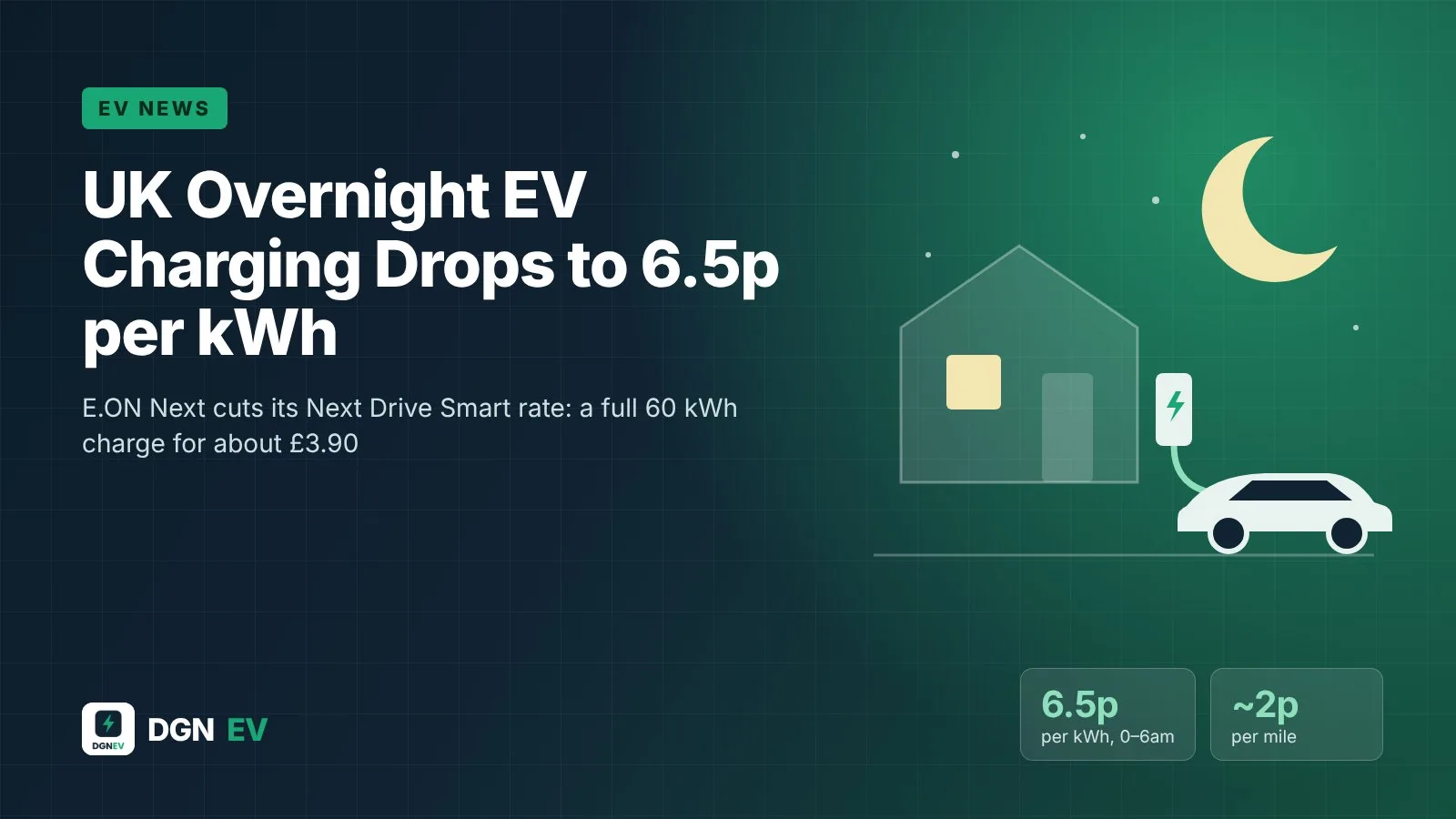
UK energy supplier E.ON Next has cut the overnight rate on its Next Drive Smart electric vehicle tariff from 8p to 6.5p per kWh. The new rate applies between midnight and 6am and took effect on October 27, 2026, as Auto Express and electrive reported. E.ON Next says it is the lowest off-peak EV rate currently available in Great Britain.
What happened
Customers on Next Drive Smart pay 6.5p per kWh for electricity used between midnight and 6am, and 34p per kWh during the rest of the day. According to electrive, the cheap rate covers the whole home during those hours, not just the car, so appliances such as a washing machine or dishwasher can also run at the lower price.
The tariff has conditions. You need:
- a smart meter that sends half-hourly readings,
- a compatible electric car and home charger,
- to let E.ON Next schedule your charging through its app.
Charging outside the overnight window, or using the app's "boost" function to charge immediately, is billed at the 34p daytime rate. The fixed-price version of the tariff, Next Drive Fixed, has also been cut, from 9p to 8.5p per kWh overnight, according to electrive.
Key numbers
| Cost | |
|---|---|
| Overnight rate (midnight–6am), before | 8p per kWh |
| Overnight rate (midnight–6am), now | 6.5p per kWh |
| Daytime rate | 34p per kWh |
| Full charge of a 60 kWh battery overnight | about £3.90 (was £4.80) |
| Energy cost per mile at 3.33 miles per kWh | about 2p |
| Standard price-cap rate, Oct–Dec 2026 (for comparison) | 26.32p per kWh |
E.ON Next says a driver covering 8,000 miles a year in a car that averages 3.33 miles per kWh could save about £476 a year compared with paying the standard price-cap rate. Our own check agrees: that driving needs around 2,400 kWh a year, which costs about £156 at 6.5p versus about £632 at the Ofgem price cap rate of 26.32p. Real-world costs will be a little higher, because roughly 10% of the energy is lost as heat during home charging.
What it means for drivers
- Home charging is now around 2p per mile on the cheapest tariffs. That is a fraction of the cost of public rapid charging, which can be ten times more expensive per kWh. Our guide to how much it costs to charge an electric car compares home and public prices in detail.
- Your daytime rate matters too. At 34p, E.ON Next's daytime rate is higher than the standard price-cap rate. If you work from home or use a lot of electricity during the day, a tariff with a slightly higher overnight rate but a cheaper daytime rate could cost you less overall. Compare your whole-home usage, not just the overnight price.
- You need a home charger and off-street parking. Smart EV tariffs only work if your car can be scheduled to charge overnight at home. Our guide to charging an electric car at home explains what equipment you need.
- Work out your own numbers. Enter 6.5p as your electricity price in our EV charging cost calculator to see the cost per charge and per month for your car.
What happens next
Tariff prices change frequently, and suppliers often respond to each other's cuts, so it is worth checking the market before you switch. For drivers without a driveway, the UK government announced in its October 2026 Budget a £100 million fund, starting in spring 2027, to cut the cost of on-street charging, and a taskforce to study letting drivers use their home tariff at some public chargers, as electrive reported. Details of how the savings will be delivered have not yet been published.
Sources and further reading
- Auto Express – E.ON delivers UK’s cheapest EV charging – autoexpress.co.uk
- electrive – E.ON Next cuts overnight EV charging rate to 6.5p/kWh – electrive.com
- Ofgem – Energy price cap, 1 October to 31 December 2026 – ofgem.gov.uk
- electrive – UK government pledges £100m to cut public EV charging costs – electrive.com
Work out your own numbers
Note: This guide is for general information only. Prices, specifications and regulations change over time and vary by country, so always check with the manufacturer or a qualified professional before making decisions. Read our disclaimer.
Keep reading
EV News Today: November 3, 2026 – Hyundai Hybrid Record, Tesla Warning, Polestar 2 Ends
Hybrids reached a record 29% of Hyundai's US sales in October while Kia's new EV3 found nearly 1,000 buyers. Tesla owners learn the cost of…
Tesla Sales Jump in Northern Europe in October as Chinese Brands Hit a Record in Norway
Tesla registrations rose 248% in Sweden and 131% in Norway in October 2026, but Chinese brands took a record 22.5% of Norway's new car market.
China's EV Makers in October 2026: Leapmotor Tops 100,000 Again as Xpeng and Xiaomi Pass 50,000
Leapmotor delivered 106,127 cars in October 2026, Xpeng a record 50,237 and Xiaomi more than 50,000, while Nio, Li Auto and Huawei's HIMA brands…
Comments
Be the first to comment
Questions and experiences are welcome. Comments are reviewed before publishing; links are not allowed. Your email is optional and never shown.