How Much Does Towing Reduce EV Range? Real Test Results
Towing a trailer typically cuts an electric truck or SUV's range by 40% to 60%, and sometimes more with heavy or tall trailers at highway speed. Here is what real tests show and how to plan a towing trip with an EV.
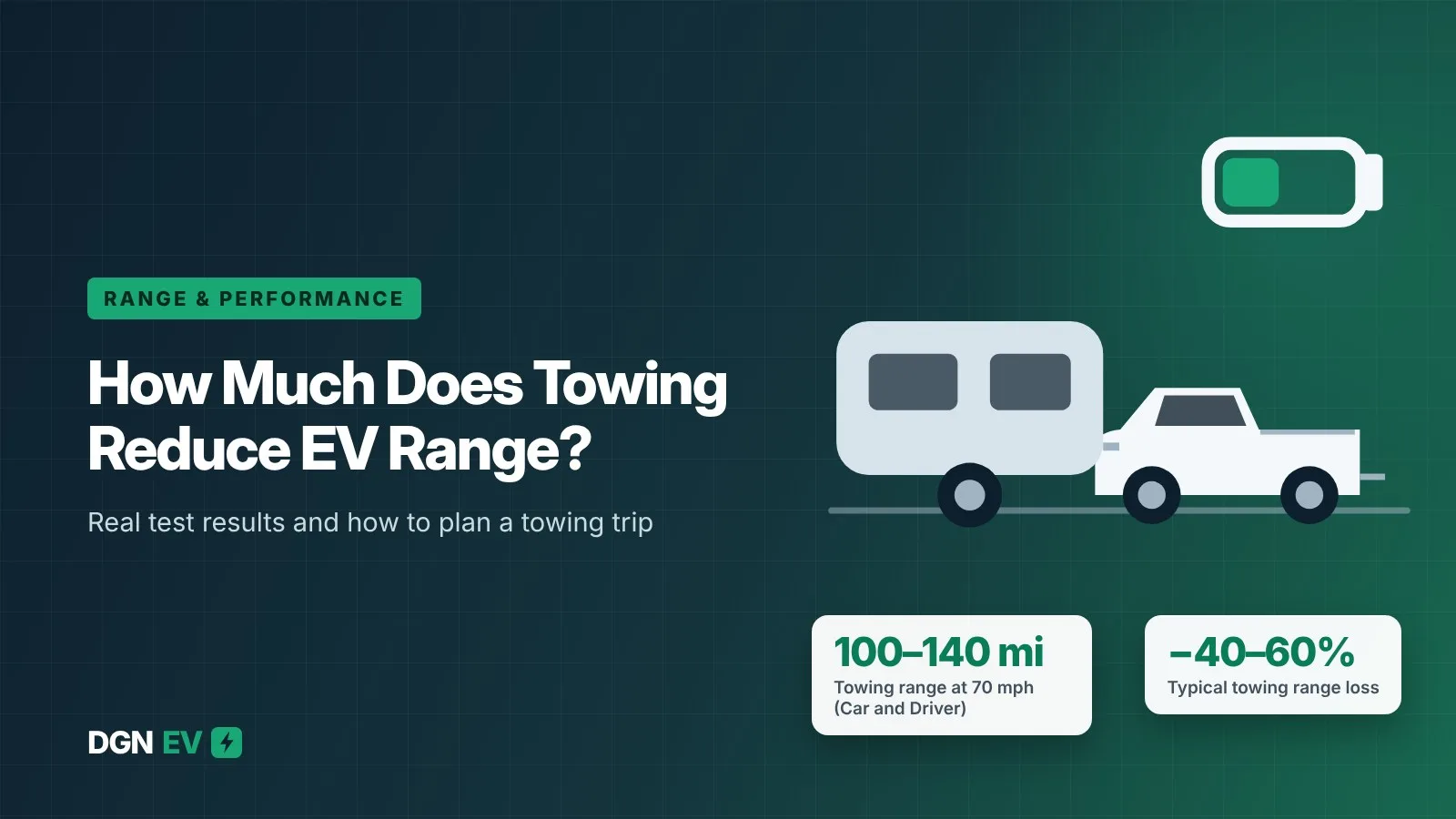
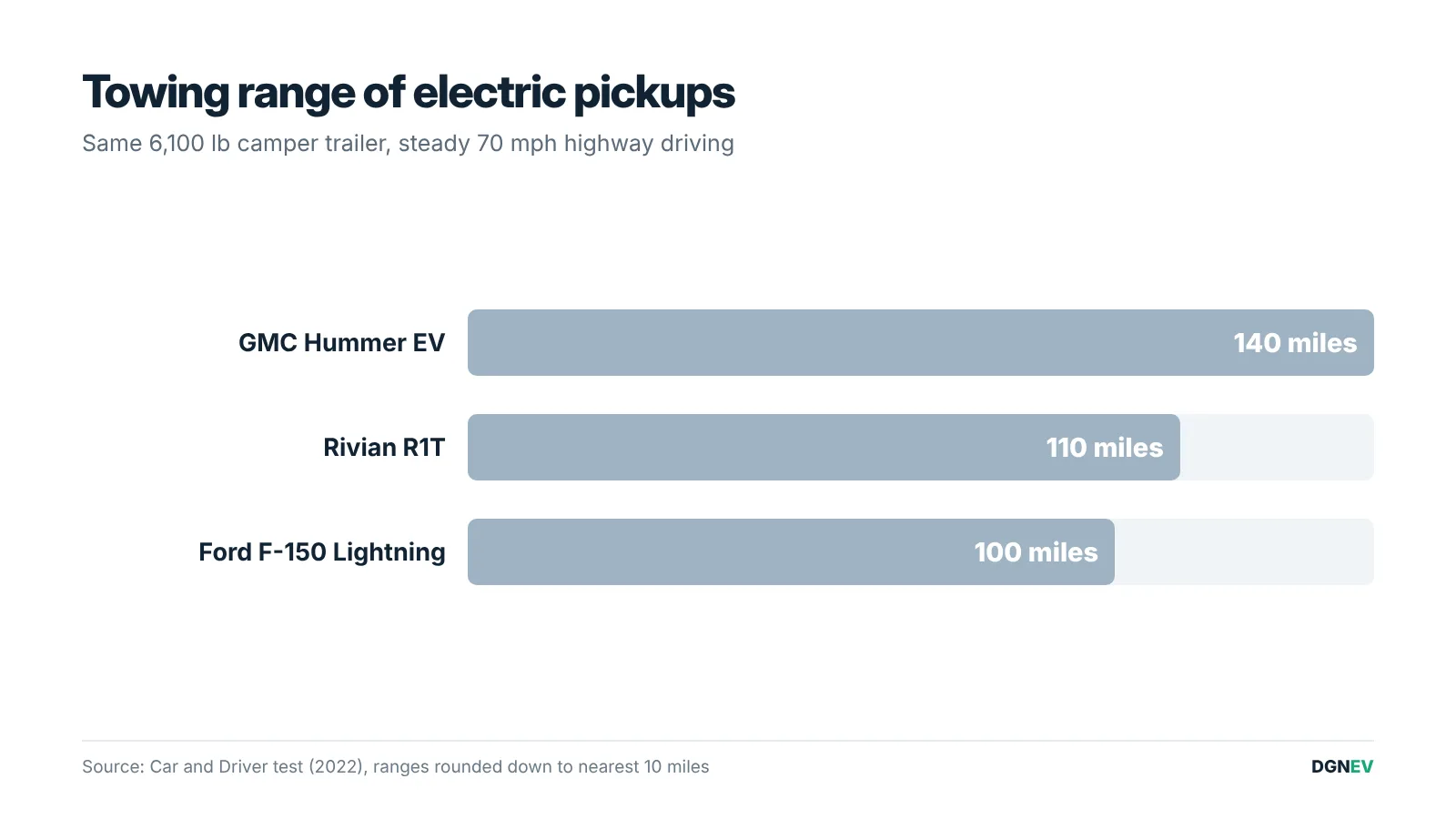
Towing a trailer usually cuts an electric vehicle's range by roughly 40% to 60%, and heavy, tall trailers at highway speed can cut it by two-thirds. In a well-known Car and Driver test, three electric pickups towing the same 6,100-pound camper at 70 mph managed only 100 to 140 miles before needing a charge. Gas trucks lose range when towing too, but they start with far more range and refuel in minutes, so the difference matters much more in an EV.
What real-world tests show
| Test | Vehicle | Trailer | Result |
|---|---|---|---|
| Car and Driver (2022), 70 mph | GMC Hummer EV | 6,100 lb camper | About 140 miles |
| Car and Driver (2022), 70 mph | Rivian R1T | 6,100 lb camper | About 110 miles |
| Car and Driver (2022), 70 mph | Ford F-150 Lightning | 6,100 lb camper | About 100 miles |
| Consumer Reports | Rivian R1T, F-150 Lightning | 10,000 lb | Around one-third of EPA range |
| The Fast Lane Truck (via Kelley Blue Book) | Rivian R1T | 2,000 lb camper | 153 miles, about 45% below rated range |
The pattern is consistent across tests: the heavier the trailer and the faster you drive, the bigger the loss. Small, light trailers hurt range less, but even a 2,000-pound camper with a large front area can cost close to half the range because of wind resistance.
Why towing hits EV range so hard
Aerodynamic drag
At highway speeds, most of the energy a vehicle uses goes into pushing air out of the way. A tall, boxy trailer can more than double the drag of a pickup. Because drag rises with the square of speed, driving at 75 mph instead of 60 mph makes the problem much worse.
Extra weight
Weight mostly matters when accelerating and climbing hills. EVs recover some of that energy with regenerative braking on the way down, which is why towing in stop-and-go traffic or rolling hills is less punishing than steady highway driving into a headwind.
Why it feels worse than in a gas truck
A gas pickup might also lose 30–50% of its fuel economy when towing, but it may still have 300+ miles of range and can refuel anywhere in five minutes. An EV starting at 300 miles can drop to 120–150 miles, and charging takes longer. Keep in mind that rated range figures already assume fairly gentle driving with no trailer.
How to estimate your towing range
A simple rule of thumb: start with your EPA range and halve it for a medium-size camper at highway speed. Then adjust:
- Small, low utility trailer at 55–60 mph: expect around 60–75% of normal range.
- Mid-size camper (5,000–7,000 lb) at 65–70 mph: expect around 35–50%.
- Heavy trailer near the tow rating, hills or wind: plan for one-third or less.
- Cold weather: subtract another 10–30% on top.
Watch your energy use (kWh per 100 miles or miles per kWh) for the first 20–30 miles of a trip; it is the best predictor of what you will actually get. You can test scenarios with our EV range calculator.
Charging while towing
Charging is often the harder part of towing with an EV:
- Most fast chargers are pull-in spaces. You often need to unhitch the trailer to reach the plug, which adds time. Pull-through stations exist but are still uncommon.
- You will stop about twice as often. Plan legs of 80–120 miles and charge to around 80%, where charging is fastest.
- Check apps before you go. PlugShare and your carmaker's app show station layouts, user photos and recent check-ins, so you can see if a site has trailer-friendly spaces.
- Use the built-in trip planner with towing mode turned on. Many trucks adjust range estimates when they detect a trailer.
See our guide on how long it takes to charge an electric car to estimate how long each stop will take.
Tips to tow farther
- Slow down. Dropping from 70 to 60 mph is the single most effective change.
- Choose an aerodynamic trailer. Low, rounded campers and pop-ups cost far less range than tall square boxes.
- Use the biggest battery available if you tow regularly.
- Precondition the battery and cabin while plugged in before you leave.
- Check tire pressures on both the vehicle and the trailer.
- Never exceed the tow rating or payload limit listed in your owner's manual and on the door-jamb sticker.
Is an EV a good tow vehicle?
EVs are excellent at the actual work of towing: instant torque makes pulling away and climbing hills easy, and the heavy, low battery keeps them stable. The weakness is range and charging. An electric truck makes most sense for short and medium tows, such as moving a boat to a nearby lake or hauling equipment locally, ideally with home charging at the end of the day. For frequent long-distance towing, a gas, diesel or hybrid truck is still more practical for most people today.
FAQ
How far can an electric truck tow on one charge?
Typically 100–150 miles with a mid-size camper at highway speed, based on published tests. Lighter trailers and lower speeds can extend that.
Does towing damage an EV battery?
No, as long as you stay within the vehicle's tow rating. The battery management system protects the cells. Towing uses more energy, so you will simply charge more often.
Can electric SUVs tow?
Many can, usually with lower tow ratings than pickups. Check the rating for your exact version, and expect the same percentage range loss as with trucks.
Is it cheaper to tow with an EV than a gas truck?
Per mile, often yes, especially if you charge at home. But frequent fast charging during towing trips can narrow or eliminate the difference.
The bottom line
Plan on losing about half your range when towing, more with big trailers at highway speed. EVs pull with ease, but you will stop to charge every 100 miles or so on long trips. If your towing is mostly local, an electric truck can do the job well; for frequent long hauls, do the math carefully first.
Work out your own numbers
Note: This guide is for general information only. Prices, specifications and regulations change over time and vary by country, so always check with the manufacturer or a qualified professional before making decisions. Read our disclaimer.
Keep reading
EPA vs WLTP vs Real-World EV Range: Why Your Range Is Different
Your EV's official range is a lab number. Learn how EPA, WLTP and CLTC ratings are measured, why real-world range can be higher in town but lower on…
Why Does EV Range Decrease in Winter? (And How to Get More)
Electric cars typically lose 20–30% of their range in freezing weather – and more in extreme cold. Here is why it happens, how much range different…

Electric Cars: Pros and Cons You Should Know
Electric cars are cheaper to run and maintain, but they cost more to buy and need more planning on long trips. Here are the real advantages and…
Comments
Be the first to comment
Questions and experiences are welcome. Comments are reviewed before publishing; links are not allowed. Your email is optional and never shown.