Tesla Model 3 (2026): Price, Range, Charging Time and Costs
The 2026 Tesla Model 3 starts at $36,990 and goes up to 363 miles on a charge. Here is every version compared on price, EPA range, charging speed, weight and what it really costs to run.
The 2026 Tesla Model 3 costs $36,990 to $54,990 before the $1,390 destination fee in the US, and its EPA-estimated range runs from about 316 to 363 miles (509–584 km) depending on the version. Charged at home at the average US electricity price, it costs roughly $4.40 to $5.60 per 100 miles to drive.
Below you will find every 2026 Model 3 version side by side, how long it takes to charge at home and on a Supercharger, what it really costs to run, and what to check if you are buying a used one. All figures were checked in early November 2026.
2026 Tesla Model 3 prices and versions
Tesla sells four versions of the Model 3 in the US for the 2026 model year. The cheapest, the Model 3 Standard (often listed simply as "Model 3 RWD"), arrived in October 2025 with fewer features to bring the price down. The old "Long Range" name has been replaced by Premium.
| Version | Base price | With $1,390 destination | Drive | 0–60 mph |
|---|---|---|---|---|
| Model 3 Standard | $36,990 | $38,380 | Rear-wheel drive | 5.8 s |
| Model 3 Premium RWD | $42,490 | $43,880 | Rear-wheel drive | 4.9 s |
| Model 3 Premium AWD | $47,490 | $48,880 | All-wheel drive | 3.8 s* |
| Model 3 Performance | $54,990 | $56,380 | All-wheel drive | 2.9 s |
*Tesla cut the Premium AWD's 0–60 time from 4.2 to 3.8 seconds and raised the Performance to 528 hp in an over-the-air update in October 2026, according to CarsDirect. Prices did not change with that update. Tesla also charges a small non-refundable order fee, and prices can move at any time, so always confirm the final figure in Tesla's configurator.
What the extra money buys: The Standard keeps the essentials (heated front seats, glass roof, 18-inch wheels, basic Autopilot) but drops items such as the rear touchscreen, ventilated front seats and the premium audio. The Premium versions add these, plus a bigger battery and faster home charging. The Performance adds adaptive suspension, bigger brakes, 20-inch wheels and sport seats, according to Edmunds.
UK prices: In the UK the Model 3 Standard lists at £37,990 with a WLTP range of 332 miles, and the Premium Long Range RWD at £44,990 with up to 466 miles WLTP (EV Compared, October 2026). WLTP figures are always higher than EPA figures for the same car, so do not compare them directly. WLTP tests are gentler, with lower average speeds than the EPA cycle.
Tesla Model 3 range: EPA and real world
| Version | EPA range | EPA efficiency | Approx. kWh/100 mi |
|---|---|---|---|
| Standard | 321 mi (517 km) | 139 MPGe | 24 |
| Premium RWD | 363 mi (584 km) | 137 MPGe | 25 |
| Premium AWD | 346 mi (557 km) | 128 MPGe | 26 |
| Performance | 309–316 mi (497–509 km) | 111–114 MPGe | 30 |
The kWh/100 mi column is calculated from the EPA's MPGe rating (33.7 kWh = 1 gallon equivalent) and includes charging losses. The Performance figure depends on the build: Tesla quoted 316 miles after its October 2026 update, up from 309.
Real-world range is better than you might expect. In Edmunds' standard test (about 60% city and 40% highway driving), a 2026 Model 3 Standard covered 339 miles, beating its 321-mile rating, and a Premium RWD went 393 miles against its 363-mile rating. At a steady 70–75 mph on the highway, expect noticeably less, often 10–15% below the EPA number. Cold weather cuts range further, especially on short trips with the cabin heater running.
Tesla Model 3 battery size (kWh)
Tesla does not publish battery capacity for the Model 3, so every kWh figure you see is an estimate. Kelley Blue Book lists the Premium and Performance at 75 kWh, and most independent estimates put them just under 80 kWh gross. The Standard uses a smaller pack, believed to be under 70 kWh.
The chemistry matters for daily charging. If your Model 3's charging screen recommends setting the limit to 100% and charging fully at least once a week, it has an LFP (lithium iron phosphate) battery. If it recommends a daily limit of around 80–90%, it has a nickel-based battery. Our guide on whether you should charge your EV to 100% explains the difference.
Tesla Model 3 charging time
Supercharging (DC fast charging)
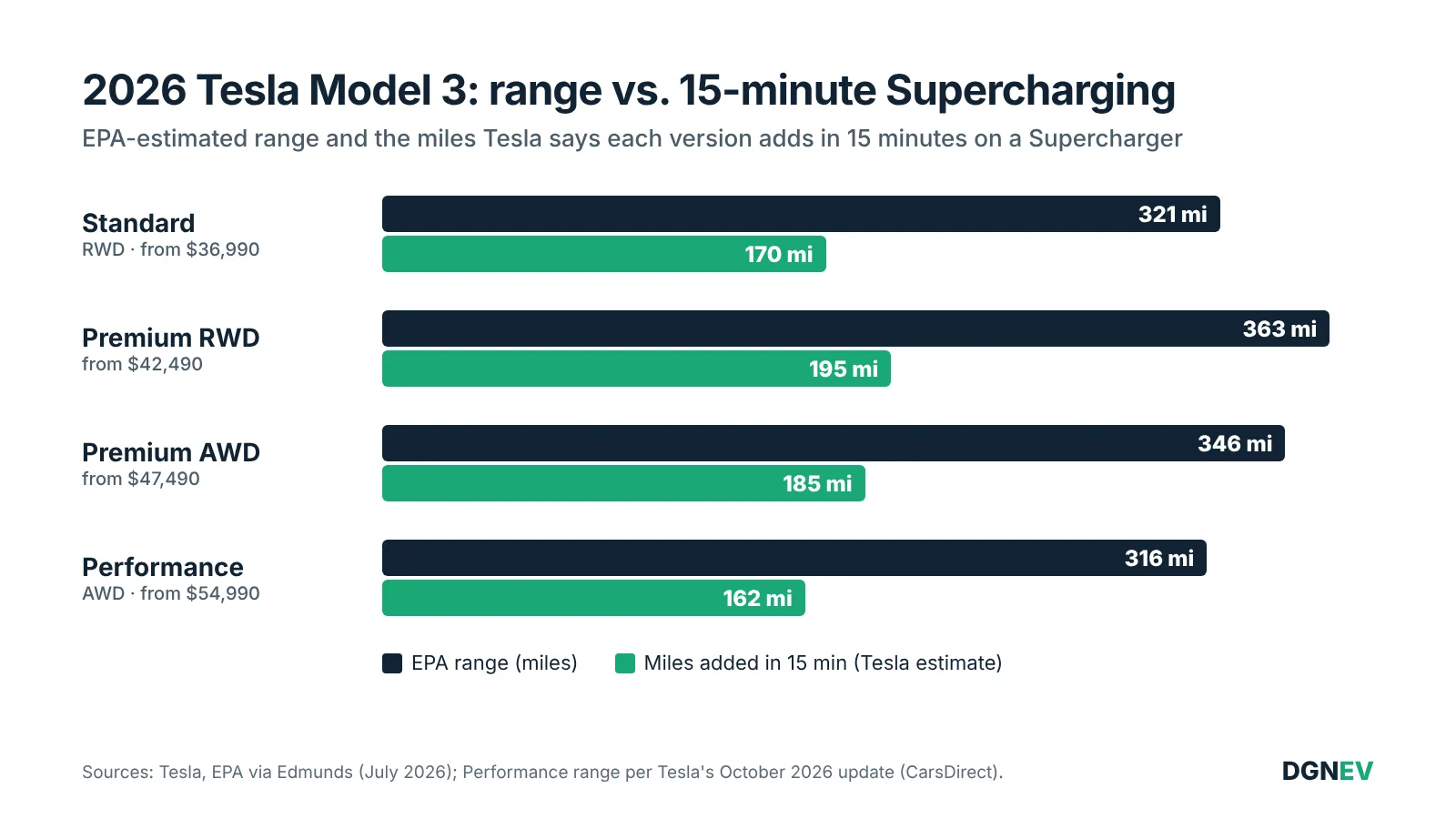
The Premium and Performance versions charge at up to 250 kW on a V3 or V4 Supercharger. The Standard peaks at about 225 kW. In practice, a 10–80% charge takes about 25–30 minutes in good conditions. Tesla's own estimates for range added in 15 minutes are:
- Standard: up to 170 miles
- Premium RWD: up to 195 miles
- Premium AWD: up to 185 miles
- Performance: up to 162 miles
These assume a warm battery and a fast charger. Use the car's navigation to drive to the Supercharger, because it pre-heats the battery automatically on the way.
Charging at home
Most owners do most of their charging at home. The onboard charger limits how fast the car can take AC power, according to Tesla:
| Charging method | Standard (7.7 kW, 32 A) | Premium / Performance (11.5 kW, 48 A) |
|---|---|---|
| 120 V household outlet (Level 1) | About 3–5 miles per hour | About 3–5 miles per hour |
| 240 V Wall Connector (Level 2) | About 28–30 miles per hour | About 35–42 miles per hour |
| Empty to full on Level 2 (estimate) | About 8–10 hours | About 7–8 hours |
These are our estimates based on charger power and EPA efficiency, so real times vary with temperature and battery size. To get the full 11.5 kW, the Premium and Performance need a 60-amp circuit. Have a licensed electrician check your panel first. Our guides to charging an electric car at home and how long it takes to charge an EV go into more detail.
How much does it cost to charge a Tesla Model 3?
We used the US average residential electricity price of 18.34 cents per kWh (EIA, June 2026) and the average Supercharger member rate of 43.4 cents per kWh, which Tesla owners pay automatically (DCFC Tracker, November 2026).
| Version | Per 100 mi at home | Per 100 mi Supercharging | 12,000 mi/year at home |
|---|---|---|---|
| Standard | $4.44 | $10.50 | $533 |
| Premium RWD | $4.51 | $10.68 | $541 |
| Premium AWD | $4.83 | $11.43 | $579 |
| Performance | $5.57 | $13.18 | $669 |
For comparison, a 30-mpg gas car costs about $13.83 per 100 miles at the AAA national average of $4.15 a gallon (November 3, 2026), or about $1,660 a year for 12,000 miles. That makes home charging roughly two-thirds cheaper. A typical 10–80% Supercharger stop on a Premium costs about $20–25 at the member rate.
Your own cost depends on your local electricity rate and whether you use off-peak pricing. Try our Tesla charging cost calculator, which has presets for every Model 3 version. Our article on how much it costs to charge an electric car includes UK prices too.
Weight, size and warranty
- Weight: about 3,760 lb (1,705 kg) for the Standard RWD (Cars.com) and about 4,030–4,050 lb (1,830–1,840 kg) for the Premium and Performance (Kelley Blue Book).
- Size: about 185 inches (4.7 m) long, with a trunk plus a front trunk ("frunk") for extra storage.
- Basic warranty: 4 years or 50,000 miles.
- Battery and drive unit warranty: 8 years or 100,000 miles on the Standard RWD, and 8 years or 120,000 miles on the Premium and Performance, with at least 70% battery capacity retained (Tesla).
Battery replacement outside warranty is rare but expensive. Planning estimates for a Model 3 pack run from about $13,000 to $22,000 depending on the battery (Jouleio, September 2026). You can test your own numbers with our EV battery replacement cost calculator, and see real degradation data in how long EV batteries last.
Buying a used Tesla Model 3: what to check
The Model 3 has been on sale since 2017, so there are plenty of used ones. In November 2026 listings, median asking prices ranged from about $20,000 for 2018–2019 cars to about $38,000 for 2024 models (VehiSales; CarGurus showed a similar spread). A few points to keep in mind:
- 2024 and newer cars have the redesigned body and interior, which is quieter, with a rear passenger screen and ventilated front seats on most versions.
- 2021 and newer cars have a heat pump, which helps winter range. Earlier cars use a less efficient resistive heater.
- Older "Standard Range Plus" cars have the shortest range, around 220–260 miles EPA depending on the year.
- Check the battery: on the car's touchscreen, compare the range at 100% with the original EPA figure, or ask for a battery health report. Battery and drive unit warranty coverage runs from the original delivery date.
Our guide What to know before buying an electric car has a full checklist.
Tesla Model 3 pros and cons
| Pros | Cons |
|---|---|
| One of the most efficient EVs sold, so running costs are low | The Standard has slower home charging (7.7 kW) and fewer features |
| Up to 363 miles of EPA range | Most controls are on the touchscreen |
| Access to the Supercharger network, built-in navigation that plans charging stops | Firm ride on the Performance with 20-inch wheels |
| Strong real-world range in independent tests | Prices and features change often, sometimes mid-year |
If you need more space or a higher seating position, compare it with our Tesla Model Y guide, which uses the same powertrains.
FAQ
How much is a Tesla Model 3 in 2026?
In the US, the 2026 Model 3 starts at $36,990 for the Standard, $42,490 for the Premium RWD, $47,490 for the Premium AWD and $54,990 for the Performance. Add the $1,390 destination fee and taxes.
How far can a Tesla Model 3 go on one charge?
The EPA rates the 2026 Model 3 at 321 miles (Standard), 363 miles (Premium RWD), 346 miles (Premium AWD) and up to 316 miles (Performance). In mixed driving, independent tests have beaten these numbers. At high highway speeds or in winter, expect less.
How long does it take to charge a Tesla Model 3?
On a Supercharger, about 25–30 minutes from 10% to 80%. On a 240-volt home charger, about 7–10 hours from empty to full, depending on the version. A regular 120-volt outlet adds only 3–5 miles per hour.
How much does a Tesla Model 3 weigh?
About 3,760 lb (1,705 kg) for the Standard RWD and about 4,030–4,050 lb (1,830–1,840 kg) for the Premium and Performance versions.
Is the Model 3 Standard worth it?
If you mostly drive locally and can charge at home overnight, the Standard gives you 321 miles of EPA range for $5,500 less than the Premium RWD. If you take frequent road trips or want faster home charging and more comfort features, the Premium RWD offers the best range in the lineup.
The bottom line
The 2026 Tesla Model 3 is one of the cheapest EVs to run in the US, at around $4.50 per 100 miles when charged at home. The Premium RWD gives the most range for the money, the Standard is the value pick for drivers who charge at home, and the Performance is for those who want speed more than range. Prices and specs change often, so we will update this guide as Tesla makes changes. For more Tesla guides, see our Tesla page.
Sources and further reading
- CarsDirect – 2026 Tesla Model 3 Mid-Year Changes Explained – carsdirect.com
- Edmunds – 2026 Tesla Model 3 Pricing Guide – edmunds.com
- InsideEVs – The Cheapest Tesla Model 3 Just Beat Its EPA-Estimated Range – insideevs.com
- Tesla – Onboard Charger – tesla.com
- U.S. Energy Information Administration – Average Price of Electricity to Ultimate Customers – eia.gov
- DCFC Tracker – Supercharger Charging Price Report, November 2026 – dcfctracker.com
- Tesla – Vehicle Warranty – tesla.com
Work out your own numbers
Note: This guide is for general information only. Prices, specifications and regulations change over time and vary by country, so always check with the manufacturer or a qualified professional before making decisions. Read our disclaimer.
Keep reading
Tesla Model Y (2026): Range, Charging Time and Real-World Costs
The 2026 Tesla Model Y starts at $41,630 and offers 294 to 357 miles of EPA range depending on the version. Here is every trim compared, how fast it…

Electric Cars: Pros and Cons You Should Know
Electric cars are cheaper to run and maintain, but they cost more to buy and need more planning on long trips. Here are the real advantages and…
Do EV Tires Wear Faster? How to Make Them Last Longer
Tires are often the biggest regular maintenance cost of an electric car – and they can wear out faster than on a gas car. Learn why, what makes EV…
Comments
Be the first to comment
Questions and experiences are welcome. Comments are reviewed before publishing; links are not allowed. Your email is optional and never shown.